
B2B guide • CNC sourcing and nearshoring
Outsourcing CNC Machining to Poland: How to Find and Select a Supplier
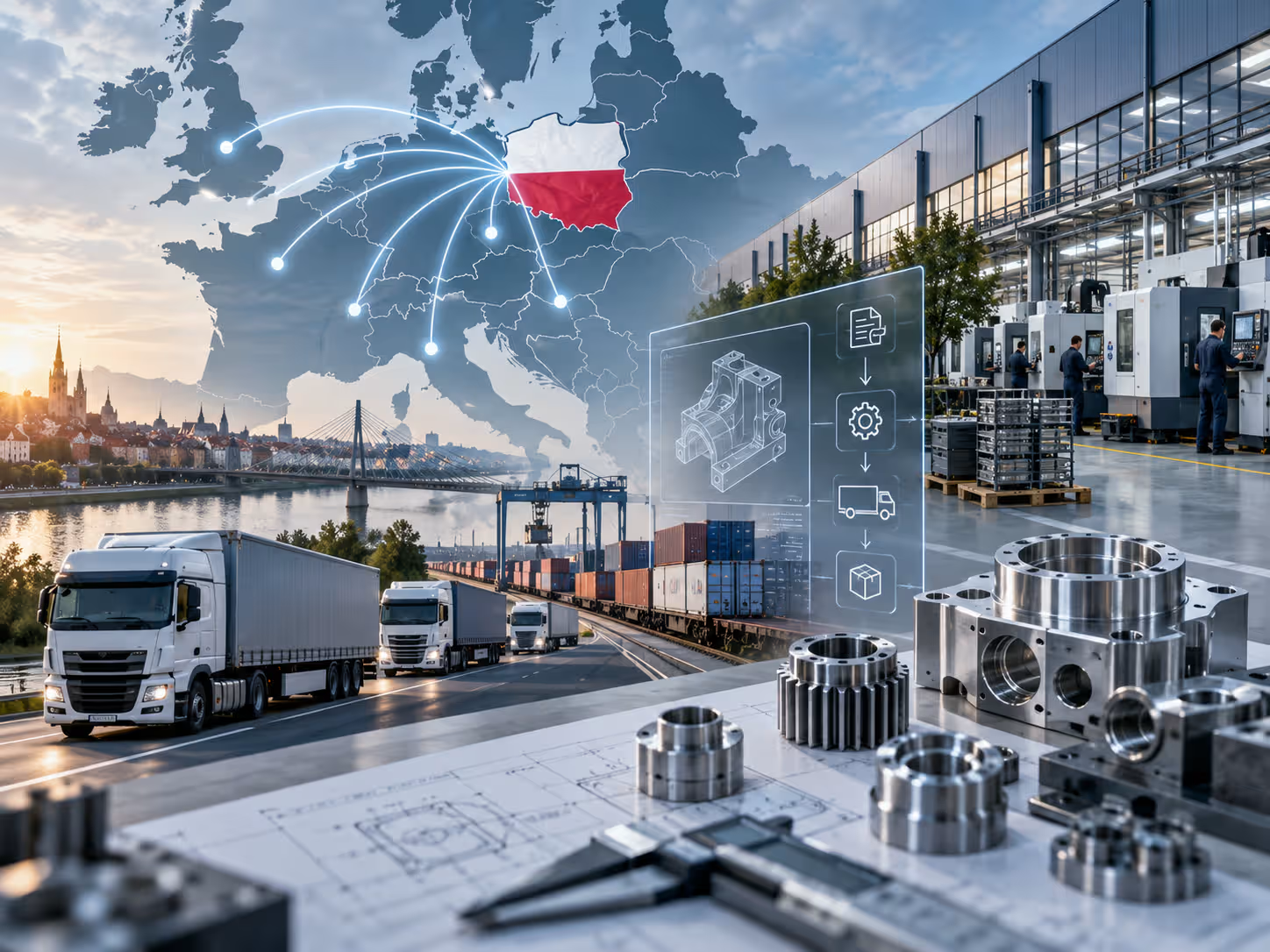
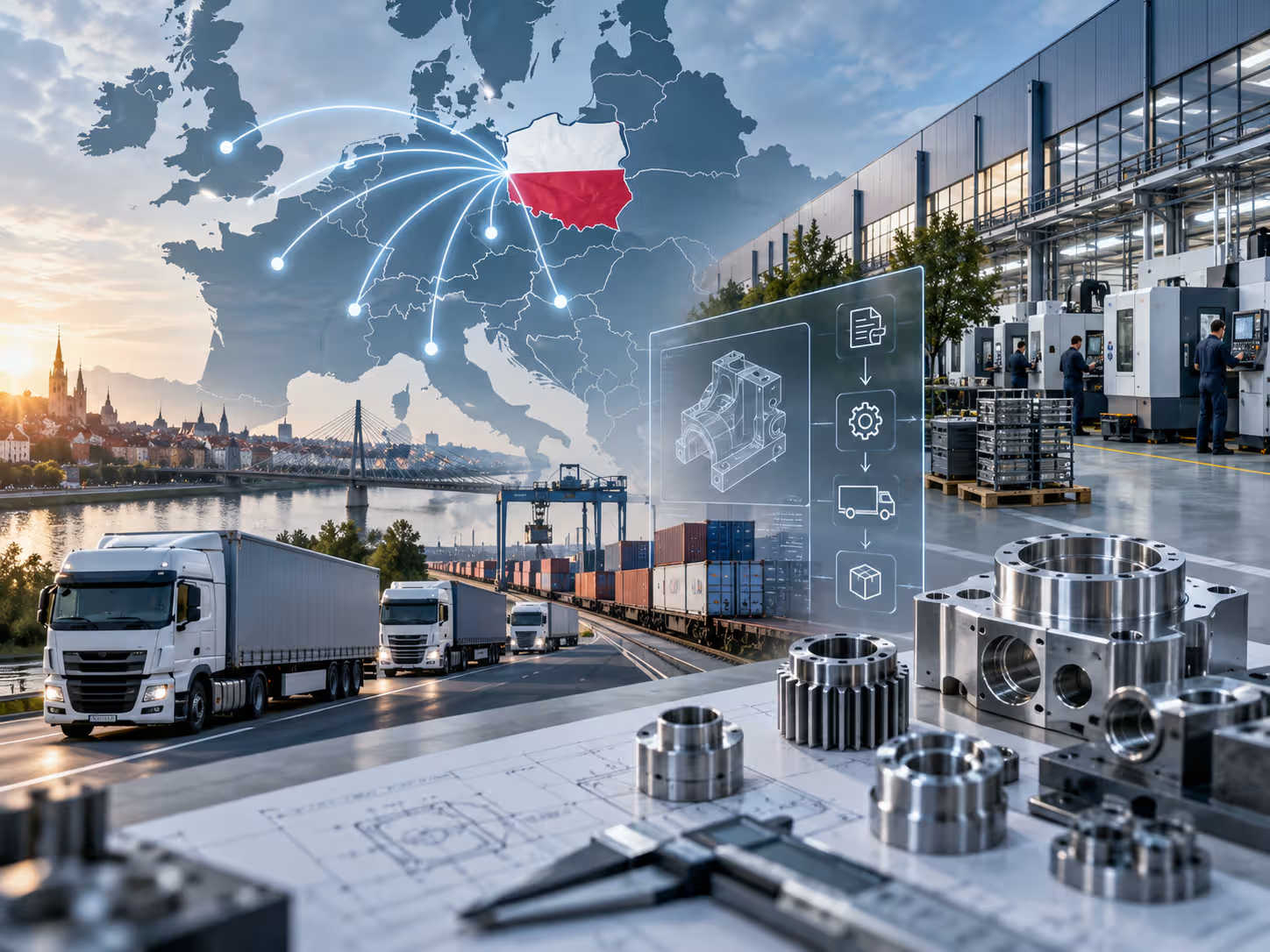
Poland combines relatively lower labour costs, a broad industrial base and short supply chains to Western Europe. However, the economics of outsourcing depend on the capabilities of the specific facility, part requirements, available capacity, quality and the total delivered cost.
Key takeaways
The Polish market is broad and diverse. Useful reference points include 425 companies in a broad activity class and an estimated 1,3–2,5 thousand entities requiring further verification.
Poland is closely integrated with European industry. In 2025, Germany accounted for 26,9% of Polish exports, while machinery, equipment and transport equipment represented 37,1% of Poland's total exports. These figures do not measure the CNC services market, but they show the scale of Polish manufacturers' links with European supply chains.
At the supplier search stage, Metal Navigator can be used to identify Polish metalworking companies and build an initial shortlist. Finding a company is only the first step: before placing an order, its technical capabilities, quality, available capacity and commercial terms must be confirmed separately.
Why consider Poland
Labour costs and market proximity
In 2025, the statistical labour cost in manufacturing was 17,10 EUR/h in Poland, 20,20 EUR/h in the Czech Republic and 49,50 EUR/h in Germany. On this measure, labour costs in Poland were about 65,5% lower than in Germany and 15,3% lower than in the Czech Republic.
| Country | Labour cost |
|---|---|
| Poland | 17,10 EUR/h |
| Czech Republic | 20,20 EUR/h |
| Germany | 49,50 EUR/h |
A cost advantage is most likely where labour remains a significant share of the total and the productivity of the Polish facility is comparable with alternative sources.
A short European supply chain
Road transport from Poland to Germany takes about 2–3 days. By comparison, transport from Turkey takes about 5–9 days, while sea freight from China is measured in tens of days.
Proximity creates the most value when it changes how procurement is organised. Shorter transport can enable more frequent deliveries in smaller batches, reduce inventory in transit and speed up the response to documentation changes. Plant visits, audits and sample exchanges also become easier.
The benefit can be reduced if the supplier requires large minimum batch sizes, has a long production lead time or operates with limited flexibility. Distance alone does not determine the advantage; the entire delivery model matters.
What Polish CNC suppliers can offer
The Polish market includes small engineering workshops, facilities focused on series production, exporters, suppliers serving sectors with higher requirements, and companies belonging to larger industrial groups. Selection should reflect the nature of the project, not simply the size of the company.
Turning and bar machining
The market offers several variants of turning:
- standard CNC turning;
- bar machining;
- Swiss-type machining;
- turn-mill machines;
- configurations with C-axis, Y-axis and driven tooling;
- sub-spindle configurations.
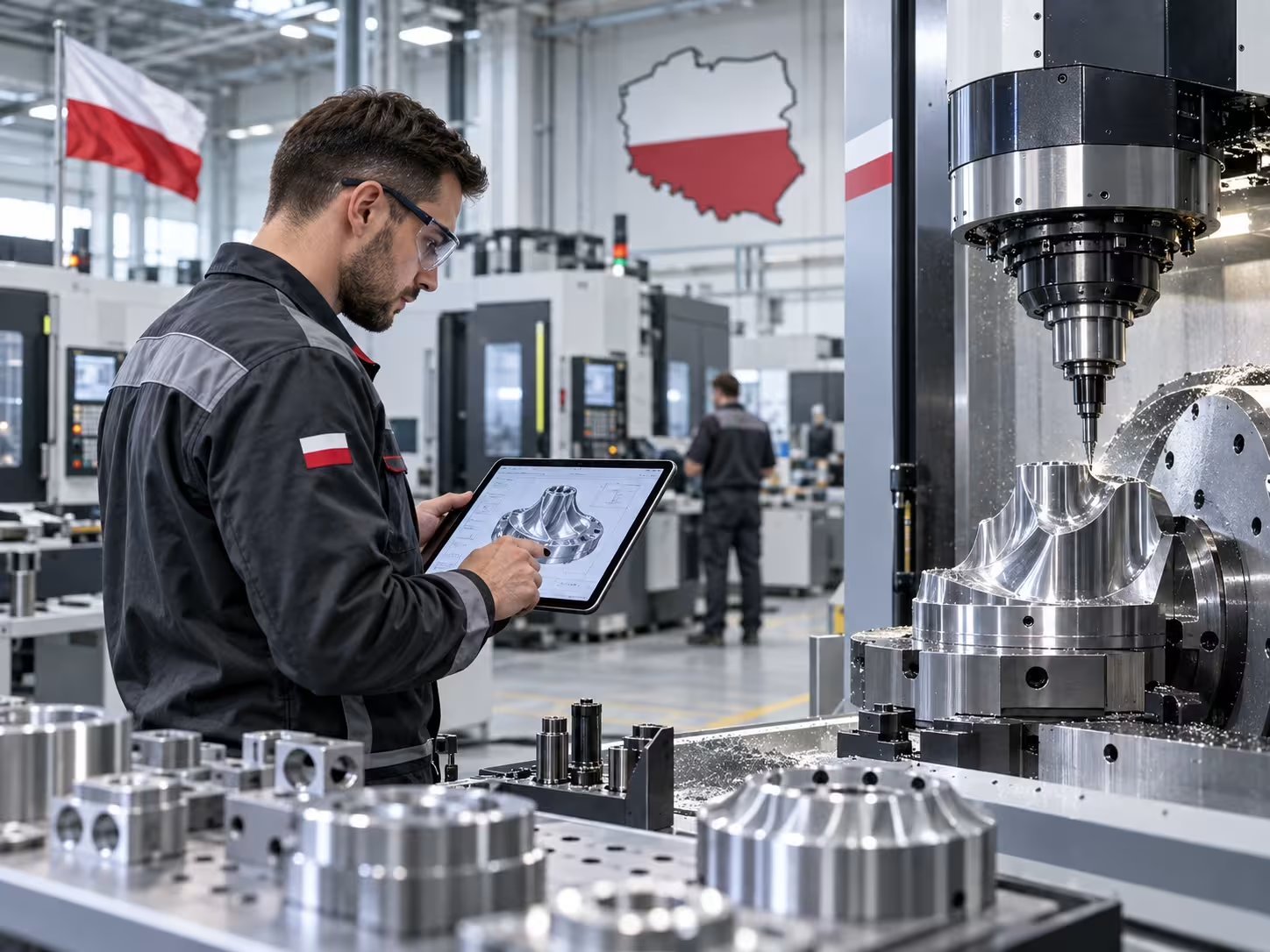
Swiss-type machines are well suited to series production of small, slender parts. For more complex components, combining turning and milling on one machine can reduce the number of set-ups, limit movement between operations and simplify process control.
Milling and multi-axis machining
Polish suppliers offer standard milling as well as more advanced multi-axis machining. When selecting a supplier, distinguish between:
- 3-axis machining;
- 3+2 machining;
- simultaneous 5-axis machining.
A general claim of “five-axis machining” is too broad. If the geometry requires simultaneous movement of five axes during cutting, confirm that the facility actually operates in this mode and that the specific machine is suitable for the part.
Large workpieces
Some facilities on the market are equipped to machine large components. Available capabilities include milling parts with dimensions of up to 12 000 × 3 500 × 2 500 mm and weights measured in many tonnes. These are capabilities of specific suppliers, not a typical market-wide standard.
For projects of this type, check all of the following:
- part dimensions;
- weight;
- fixturing method;
- tool access;
- required tolerances;
- ability to move the part safely;
- available measurement methods.
A large machine is not enough if the facility cannot fixture, move or measure the part correctly.
Additional processes
Depending on the supplier, the scope may also include:
- grinding;
- honing;
- electrical discharge machining (EDM);
- heat treatment;
- coatings;
- welding;
- assembly;
- final inspection.
Not every operation has to be performed in-house. What matters is who is responsible for the full production route, how subcontractors are qualified, and whether any change of external provider remains under the customer's control.
Materials
Polish suppliers report machining structural, alloy, stainless and tool steels, as well as aluminium, copper, cast iron, titanium, selected nickel alloys and other speciality materials.
Which projects are best suited to Polish suppliers
Small and medium batches
For shorter production runs, setup cost, programming speed, fixture preparation and changeover time matter greatly. A flexible facility can be competitive not only on labour cost, but also through efficient launch of successive batches.
Frequent deliveries
For regular deliveries to Germany, Austria, the Benelux, Scandinavia and other parts of Europe, short road transport makes smaller batch sizes easier to manage and reduces the need to hold large inventories.
Frequent documentation changes
Nearshoring is particularly attractive for parts subject to design changes. Shorter distances make design-for-manufacturability (DFM) reviews, sample exchanges, part re-approval, responses to revision changes and direct contact with manufacturing engineers easier.
Heavy components
For heavy parts with a relatively low unit value, transport from distant markets can account for a significant share of total cost. A European supplier can therefore remain competitive even if its ex-works price is not the lowest.
Second source
Poland can be a good location for establishing a second European source. However, the actual independence of both suppliers must be checked: two different facilities do not provide full redundancy if they use the same heat-treatment provider, material source, shared infrastructure or another critical resource.
What to check before selecting a supplier
A general statement of a company's capabilities should not be the basis for approval. Qualification must focus on the facility that will actually fulfil the order.
| Area | What to check |
|---|---|
| Process | Whether the required operations are available at the facility running the project |
| Machines | Configuration, working envelope and actual equipment |
| Material | Grade, condition, stock form and purchasing source |
| Part size | Dimensions, weight, fixturing method and tool access |
| Tolerances | Ability to achieve and reliably measure the required characteristics |
| Metrology | Equipment, measurement method and result reporting |
| Batches | Typical production model and changeover frequency |
| Production capacity | Availability of machines, personnel, metrology and external processes |
| Additional processes | What is performed in-house and what is subcontracted |
| Certification | Document validity, scope and the facility covered |
| Quality | Required FAI, PPAP, MSA, Cpk/Ppk or other evidence |
| Logistics | Lead time, delivery schedule and packing method |
| Commercial terms | Material, tooling, payment, Incoterms and cancellation terms |
| Data and rights | Rights to tooling, programs and documentation |
| Supply continuity | Back-up arrangements, critical resources and ability to transfer production |
A machine list shows technical potential but says nothing about available capacity. Fulfilling a new order requires the right machine, operators, programming, metrology, material and access to external processes at the same time.
A certificate does not approve a part
ISO 9001, IATF 16949, ISO 13485 and other industry standards can be useful filters early in the process. Before qualification, however, confirm:
- whether the certificate is current;
- which legal entity it covers;
- whether it covers the facility fulfilling the order;
- whether its scope matches the planned production.
A quality-management certificate does not by itself confirm the ability to manufacture a specific part or process stability for the required production run.
What an RFQ should include
The most reliable comparison is achieved when several suitably selected suppliers receive the same RFQ package.
The RFQ should include at least:
- the technical drawing, current document revision and a 3D model, if available;
- the exact material, its condition and stock form;
- required tolerances, surface requirements and critical characteristics;
- annual demand, batch size and delivery frequency;
- required first-delivery date;
- measurement, reporting and certification requirements;
- additional processes and rules for permitted subcontracting;
- packaging requirements, delivery location and agreed Incoterms;
- first article inspection (FAI), PPAP or other approval requirements, where applicable.
Annual volume alone is not enough to prepare a sound quotation. For a facility, 12 000 parts made in one campaign and 12 deliveries of 1 000 parts mean different numbers of production starts, changeovers and setup costs.
Key risks
The technology is available, but capacity is not
A facility may have the right machines and still be unable to complete the order within the required timeframe. Before selecting a supplier, confirm the actual schedule and availability across the full production route. For high volumes, process throughput should also be checked.
An external process becomes a bottleneck
Turning or milling may finish on schedule while delivery is delayed by heat treatment, coating or measurement. Before starting the relationship, understand the full production route and identify which subcontractors are responsible for critical operations.
Production follows obsolete documentation
Poor revision control can result in an entire batch being manufactured to an obsolete drawing. The current documentation version and the change-approval process should be agreed before production starts.
The facility cannot reliably verify the required characteristics
Manufacturing a part and measuring it are two separate issues. For tight tolerances, check not only the measurement equipment but also the fixturing method, measurement conditions, the method used and its uncertainty.
Production transfer proves harder than expected
If rights to tooling, programs and process data are not agreed before series production begins, a later supplier change may require part of the process to be redeveloped. Terms for transferring data and tools are best agreed before series production.
The lowest part price does not mean the lowest total cost
A low price can be offset by transport, higher inventory, additional inspections, quality issues or more work on the buyer's side. Offers should therefore also be assessed on total cost of ownership (TCO).
How to find suitable suppliers and use Metal Navigator
The fact that Poland has many CNC machining suppliers does not by itself help with a specific project. The main task is to narrow the market to companies that fit the part in terms of:
- technology;
- material;
- part size;
- production model;
- batch size;
- sector requirements;
- location;
- required additional processes.
Only after preparing such a list does it make sense to involve the procurement and engineering teams in supplier discussions, RFQs and formal qualification.
Metal Navigator
Metal Navigator helps identify Polish companies in the metalworking industry and build an initial list of potential suppliers. In a broad and fragmented market, it can make the first stage of the search more efficient before direct contact begins with selected facilities.
The tool is best used to support candidate identification and market narrowing. It does not replace an RFQ or supplier qualification. Before selecting a supplier, directly confirm the technology, material, quality requirements, production capacity, commercial terms and the specific facility's ability to deliver the project.
Recommended sourcing process in Poland
-
Define the business need
Define why a new source is needed: cost reduction, a second source, a shorter supply chain, additional capacity, greater flexibility or replacement of the current supplier.
-
Finalise the technical requirements
Prepare the current documentation, material, tolerances, volume, batch size and quality requirements. The more issues that remain open, the harder it will be to compare offers later.
-
Identify potential suppliers
Find companies that match the project's technical and organisational requirements. At this stage, Metal Navigator can be used for initial market screening.
-
Build a shortlist
Exclude companies that do not meet the basic requirements for process, material, part size, production scale or required standards.
-
Send identical RFQs
Every supplier should receive the same version of the documentation and quote the same scope of production, quality and delivery.
-
Compare technology, price and TCO
Unit price is only one criterion. Also consider logistics, external processes, quality, available capacity, commercial terms and the cost of managing the relationship.
-
Confirm the facility's actual capability
The depth of verification should reflect project risk. It may include a technical discussion, sample production, a plant visit, an audit or formal process qualification.
-
Run a pilot batch
The trial should use the agreed material and the intended production route. Only then can it reflect the actual conditions of future production.
-
Scale up the new source gradually
Full volume transfer makes sense only after quality, process stability and on-time delivery have been confirmed across successive batches. For critical parts, it is safer to retain the existing source until qualification of the new supplier is complete.
Key takeaways for buyers
- Poland is worth evaluating for European CNC projects, particularly where labour cost, short transport distances, flexibility and frequent deliveries matter.
- Poland's advantage comes from a combination of factors. Lower labour costs deliver a real benefit only when the facility also provides adequate productivity, quality and material utilisation.
- A broad supplier base provides choice, but suppliers must be filtered effectively by technology, material, production scale and project requirements.
- Machine lists and certificates are only the start of qualification. The final assessment should focus on the specific facility, part, process, material and planned production run.
- Offers can be compared reliably only when the RFQ is identical. Differences in material, quality, additional processes or transport scope can completely change the comparison.
- Poland is particularly attractive for frequent deliveries, shorter production runs, documentation changes and heavy components, as well as when rapid contact with the supplier matters.
- Metal Navigator can accelerate the first stage of the search, helping to identify Polish metalworking companies and narrow the candidate list before RFQs and qualification begin.
FAQ: CNC machining outsourcing to Poland
Can outsourcing CNC machining to Poland be cost-effective?
It can be cost-effective, particularly where labour cost, short transport distances and delivery flexibility matter. Lower labour costs do not automatically translate into a lower part price. The comparison should cover the specific offer, facility productivity, quality, logistics and total cost of ownership (TCO).
Which projects are particularly well suited to Poland?
Poland is particularly attractive for small and medium batches, frequent deliveries within Europe, documentation changes and heavy components. It can also be a good location for establishing a second European source. For large, stable production runs, automation, cycle time and overall line productivity should carry more weight.
What should an RFQ to a CNC supplier include?
The RFQ should include current documentation, the exact material and stock form, tolerances, surface requirements and critical characteristics. It should also state volume, batch size, delivery frequency, required first-delivery date, measurement and quality requirements, additional processes, packaging, delivery location and Incoterms. Every supplier should quote the same scope.
How can you verify a CNC facility's actual capabilities?
Verification should focus on the specific facility and planned project, not a general company statement. Confirm the process, machine configuration, material, part size, tolerances, metrology, available capacity, external processes and logistics. The scope may include a technical discussion, samples, a plant visit, an audit or formal process qualification.
Are a certificate and machine list enough to qualify a supplier?
No. A certificate can be a useful filter, but its validity, scope and the facility it covers must be confirmed. A machine list shows technical potential, but it does not confirm available capacity, the ability to manufacture a specific part or process stability for the required production run.
How does Metal Navigator support CNC supplier searches in Poland?
Metal Navigator helps identify Polish metalworking companies and prepare an initial list of potential suppliers. It supports the first stage of the search and market narrowing. It does not replace an RFQ or qualification: technology, material, quality, capacity and commercial terms must be confirmed directly with the specific facility.