
Market analysis and industrial sourcing
Metalworking and Energy Storage in 2026: Polish Enclosures, Frames and Skids
The expansion of utility-scale battery energy storage systems is creating new opportunities for Polish manufacturers of enclosures, frames, skids, PCS cabinets and auxiliary structures. The most realistic opportunity is not the production of battery cells or proprietary BMS and EMS platforms, but the localisation of the metal balance of plant and controlled mechanical integration. For European integrators, metalworking in Poland can mean shorter supply chains, easier factory acceptance testing, faster rework and a credible dual-sourcing option.
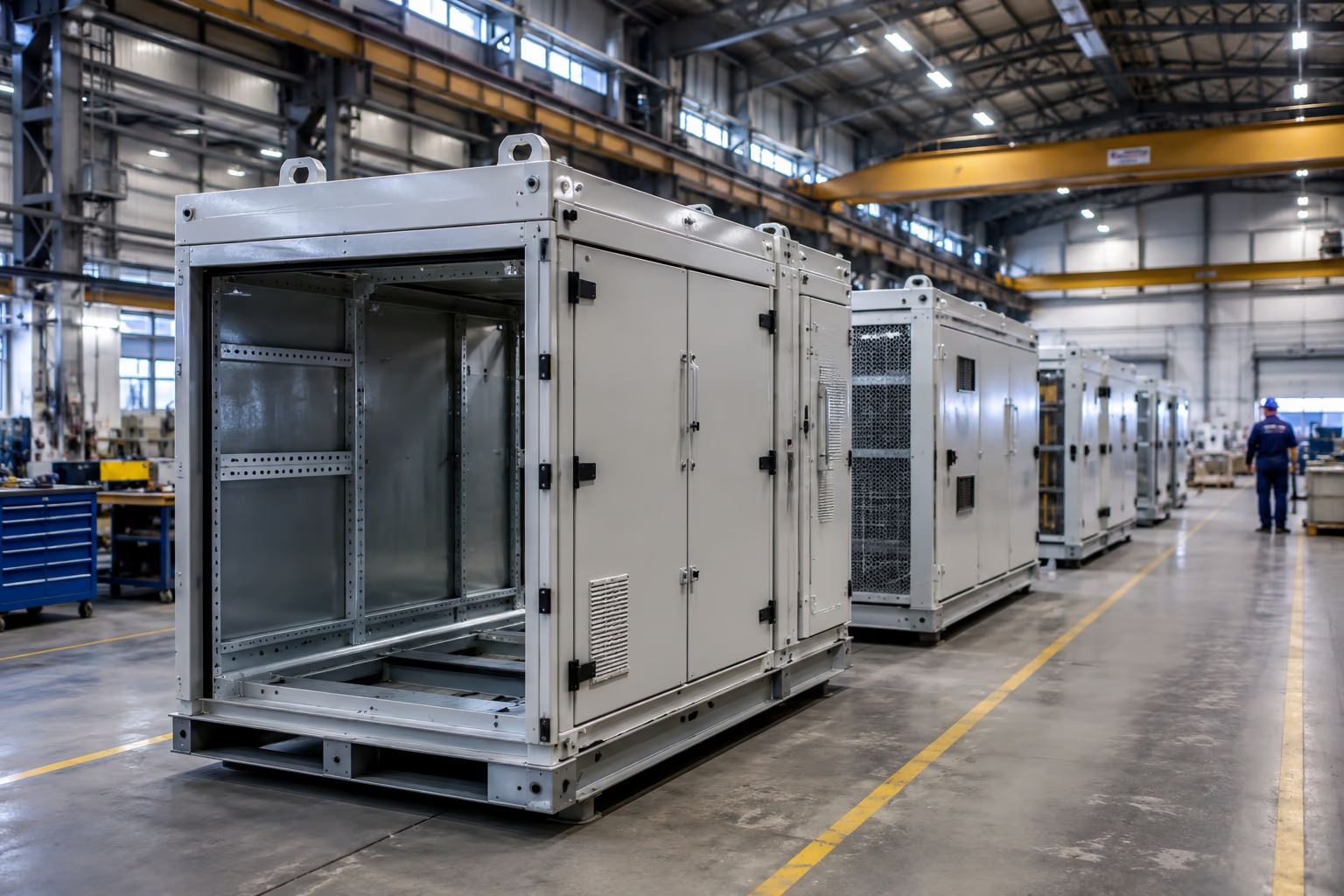
Why the BESS market creates demand for metalworking
Poland's energy storage market is not starting from zero. The Polish Ministry of Climate and Environment identifies smaller battery storage and demonstration projects in locations including Puck, Rzepedź, Garbce, Lubachów, Cieszanowice, Czernikowo and Bystrze. These projects confirm domestic construction and operating experience before the arrival of investments measured in hundreds of megawatts. Ministry of Climate and Environment
For industrial suppliers, the key factor is not simply the number of announced projects but the interaction of three mechanisms. The first is capacity-market contracting, which secures part of the future revenue of selected assets. The second is public investment support from the National Recovery Plan and the Modernisation Fund. The third is the emergence of investor and utility portfolios covering multiple locations rather than isolated pilot schemes.
As a result, integrators, EPC contractors and asset owners must plan not only the procurement of cells, PCS equipment and control systems, but also structures, enclosures, mechanical interfaces, cooling equipment and auxiliary infrastructure. For companies specialising in metal fabrication, this is an attractive market because many of its products are large, transport-intensive and subject to project-specific engineering changes.
An outdoor enclosure, a heavy equipment base, a transformer skid or a PCS cabinet can be expensive to transport and difficult to modify after delivery. In these categories, proximity to the integration site, rapid access for audits, prototype availability and efficient closure of non-conformities may be more important than the lowest price per kilogram of steel.
The eligible scope of the NFOŚiGW programme for large-scale energy storage includes battery containers, inverters, transformers, module assembly, detection and fire-protection systems, air conditioning, power converters, tests and acceptance activities. This does not guarantee orders for Polish companies, but it confirms that mechanical and auxiliary system elements form a real part of the investment scope.
BESS projects and the procurement pipeline in Poland
Żarnowiec is the clearest confirmed example of a large-scale Polish BESS project. Government and investor communications describe a system of approximately 262–263 MW and 900–981 MWh. Construction has started, completion is planned for the second quarter of 2027, and the asset is expected to benefit from a 17-year capacity-market contract from 2029. For suppliers, Żarnowiec is more than a single project announcement: it shows that the market has entered a stage requiring a complete delivery, inspection and acceptance chain. Żarnowiec
Greenvolt's projects in Turośń Kościelna and Nowa Wieś Ełcka are each reported at 200 MW and 800 MWh. For Turośń, a technical update dated 4 March 2026 confirmed energisation of the 110 kV/medium-voltage substation and identified commissioning of the battery infrastructure as the next stage. This supports describing the project as advanced, but it does not provide official confirmation of commercial operation on 30 July 2026.
For Nowa Wieś Ełcka, the report records earlier equipment-delivery and construction schedules but no later public confirmation of operational status. Neither project should therefore be presented as operational without additional official evidence. P&Q
The Siedlce project is described in the report as 600 MW and 2.4 GWh. The Greenvolt–BYD agreement anticipated construction starting in the third quarter of 2026 and operation by the end of 2027. R.Power, meanwhile, reported a portfolio covered by 17-year capacity-market contracts with 655 MW of connection capacity and approximately 2.3 GWh of storage capacity. This shows that demand is not limited to state-owned utilities. R.Power
PGE's portfolio should be presented as a range rather than a single apparently precise figure. An official government communication referred to around 80 storage projects and more than 10 GWh by 2035, while a statement by PGE's chief executive reported by Reuters referred to around 85 projects and more than 17 GWh. The programme value was presented at approximately PLN 18 billion. For buyers, the safer formulation is therefore 80–85 projects and more than 10–17 GWh, clearly identified as a strategic portfolio rather than a list of assets at the same stage of development. Reuters
Enea communicated a storage pipeline of 1,386 MW, of which 866 MW was expected to be commissioned in 2027. Public programmes cover hundreds of investments, but the published figures refer to different stages: 183 investments on a ranking list, 181 grant and loan applications concerning 172 projects, and 174 storage facilities covered by approved applications. NFOŚiGW also confirmed a combined 425 MW and 2,032 MWh for Ełk and Żarnowiec with PLN 691 million of support. Ranking-list inclusion, financing approval and construction start are not the same project status. Reuters
Turośń Kościelna and Nowa Wieś Ełcka should not be described as confirmed operational installations. The report supports their size, schedules and progress, but does not contain sufficient official evidence of commercial operation as of the analysis date.
What the metal balance of plant of an energy storage system includes
Balance of plant, or BoP, covers the equipment and infrastructure required for an installation to operate outside its core technology. In a BESS, the core typically includes cells, modules, the battery management system, the energy management system, power electronics and a significant share of the integrator's intellectual property. The metal balance of plant includes enclosures, load-bearing structures, skids, cabinets, ducts, mechanical interfaces, platforms and other elements that may be suitable for local production.
This separation supports make-or-buy decisions. The integrator can retain battery design, algorithms and critical intellectual property while providing a local manufacturer with 2D and 3D documentation, a bill of materials, test requirements and responsibility for repeatable mechanical production.
Modern BESS products are becoming increasingly prefabricated. Product materials from companies such as Sungrow and Wärtsilä show packaged blocks with front service access, separation between electrical and battery compartments, factory testing and integrated cooling. In this model, supplier value does not end with cutting and welding steel. It increasingly includes the installation of doors, seals, cable entries, fans, heat exchangers, cable trays and sensors, as well as preparation of the module for factory acceptance testing. Sungrow
The strongest opportunity for Polish companies lies between the electronics and the construction site: where large dimensions, welding, coatings, sealing, component installation, transport packaging and rapid engineering changes come together.
Which BESS components can be manufactured in Poland
The most realistic localisation candidates are products defined by controlled documentation and capable of inspection before shipment, ranging from sheet-metal fabrication to heavy welded structures. A BESS enclosure manufacturer in Poland can work under a build-to-print model using complete customer drawings or under a build-to-spec model based on functional requirements and a defined share of engineering responsibility.
The local scope may be limited to fabrication, but higher value is created through partial integration. The supplier can install purchased components, prepare openings and interfaces, conduct leak testing, package the product for transport and participate in factory acceptance testing. This model requires stronger configuration and revision control, but reduces work at the installation site.
Metal balance-of-plant components and their localisation potential
| Component | Function in the BESS | Localisation potential | Key procurement requirements |
|---|---|---|---|
| Enclosure or technical container | Equipment protection, service access and interface with the external environment. | Very high | Sealing, doors, gaskets, penetrations, service ergonomics, configuration control and coatings. |
| Welded frame or skid | Equipment support, load transfer, transport and integration of heavy equipment. | Very high | Datum tolerances, distortion control, lifting points, centre of gravity and material traceability. |
| Battery module rack | Structural support, module positioning and organisation of the installation space. | High | Dimensional repeatability, insulation, edge quality, corrosion protection and compatibility with OEM interfaces. |
| PCS cabinet or AC cabinet | Mechanical protection and integration of power-electronic equipment. | High | IP and IK of the final assembly, service access, zone separation, cooling, component installation and functional testing. |
| HVAC ducts, covers and brackets | Airflow management and protection of cooling-system components. | High | Fit, connection tightness, serviceability, material compatibility and environmental resistance. |
| Cooling manifolds and pipework components | Distribution of coolant in liquid-cooled systems. | Medium to high | Leak testing, cleanliness, material compatibility, test documentation and assembly-process stability. |
| Switchgear and medium-voltage station enclosures | Protection of electrical equipment and mechanical integration of grid-connection infrastructure. | High | Electrical interfaces, zone separation, service access, change documentation and responsibility for final testing. |
| Fire-safety partitions and auxiliary structures | Support for an architecture intended to limit event propagation and mount safety equipment. | Medium to high | Clear allocation of responsibility: a mechanical component is not equivalent to fire-safety certification of the complete BESS. |
| Platforms, stairs, barriers and cable routes | Safe operating access, protection and organised routing of installations. | Very high | Load capacity, ergonomics, corrosion protection, onsite assembly and compatibility with the site layout. |
| Cells, BMS and EMS | Core storage, monitoring and system-control functions. | Low for an independent metal fabricator | This scope normally remains with the global system OEM or integrator and is closely linked to intellectual property and system certification. |
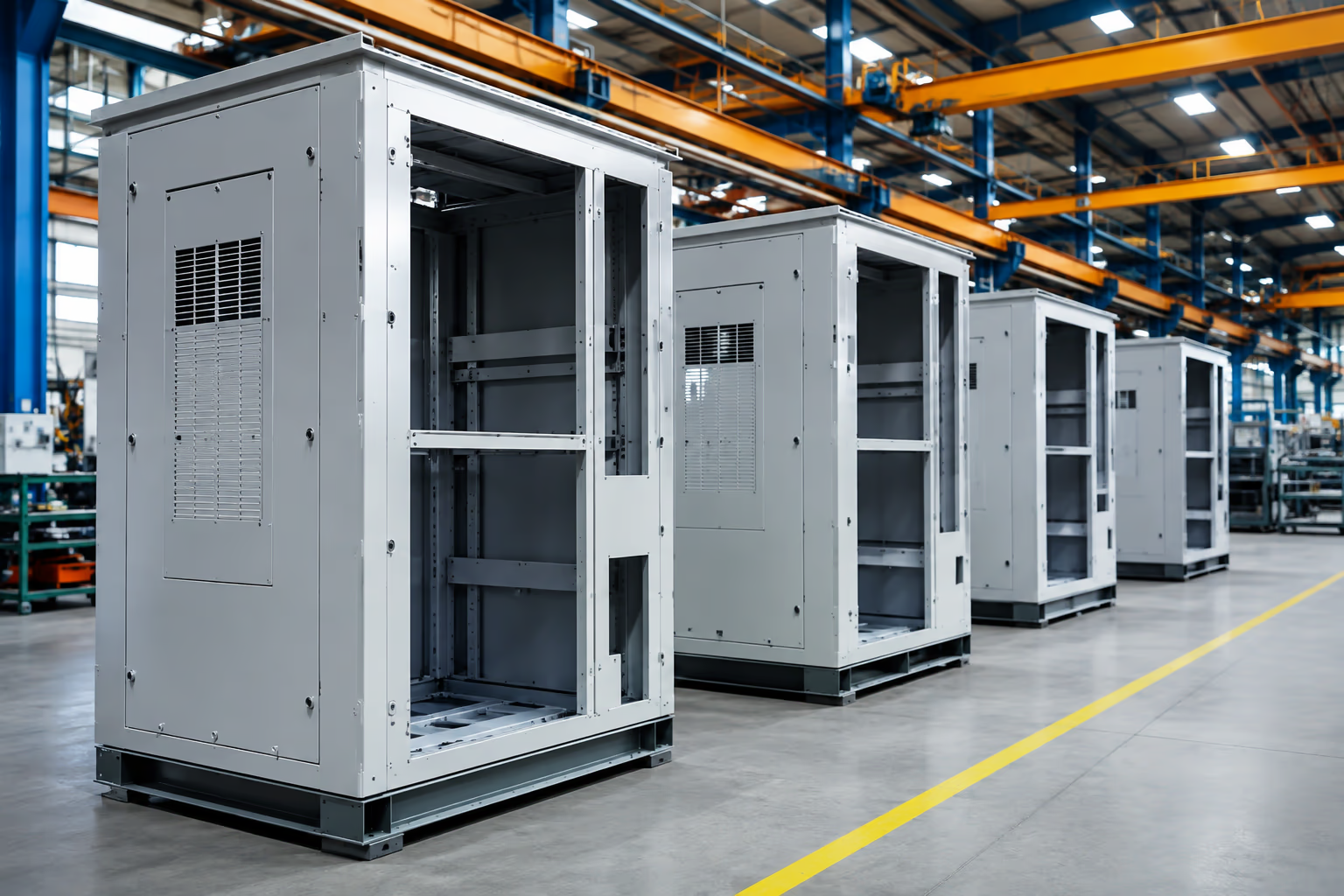
Metalworking processes required for energy storage projects
The required process chain depends on whether the supplier is producing a thin-walled cabinet, a heavy transformer base, a technical container or a partially integrated auxiliary module. Integrators generally need more than a single machine: they require a stable process from material inspection through fabrication and coating to assembly, testing and acceptance documentation.
Cutting and sheet preparation
Laser cutting, punching and, for heavier work, plasma or oxy-fuel cutting form the basis for panels, brackets, frames and mounting plates. Key controls include edge quality, part identification, thermal-distortion management and material conformity with certificates.
Bending and CNC machining
Bending provides repeatable geometry for panels and doors, while CNC milling and drilling create datum surfaces, interface holes and equipment mounting features. For skids, post-weld machining and control of critical positions can be essential.
MAG and TIG welding
MAG welding is common for carbon-steel structures, while TIG may be required for stainless steel, aluminium or selected fluid-system components. WPS and WPQR coverage, personnel competence, welding sequence and distortion-repair procedures are critical.
Coatings and surface preparation
Surface preparation, wet or powder coating and dry-film-thickness control determine the durability of outdoor products. The protective system should be based on the operating environment, required durability and ISO 12944 rather than a generic specification such as “industrial paint”.
Mechanical assembly and sealing
Installing doors, locks, hinges, seals, glands, fans, heat exchangers and cable routes moves the supplier towards partial integration. This requires controlled work instructions, torque control, component identification and documented leak or water testing.
Dimensional inspection, FAI and FAT
First article inspection confirms a new process or configuration. Factory acceptance testing may cover dimensions, door operation, component fit, sealing, marking, documentation and closure of the punch list before shipment.
A mature supplier should not treat a machine list as sufficient proof of capability. Buyers need evidence of actual maximum dimensions, crane capacity, material range, coating-subcontractor stability, metrology resources, rework capability and the ability to move from prototype to serial production. Packaging, transport protection, centre-of-gravity marking and lifting points are also critical for enclosures and skids.
Metalworking outsourcing and dual sourcing for BESS
Metalworking outsourcing should not be understood only as moving operations to a lower-cost factory. In BESS projects it can increase capacity, shorten industrialisation time, provide access to specialised processes and secure an alternative source. For large components in particular, a European source can reduce transport risk and improve responsiveness to documentation changes.
The simplest cooperation model is build-to-print: the integrator supplies approved drawings, a bill of materials and an inspection plan, and the supplier is responsible for compliant manufacturing. Build-to-spec gives the manufacturer a larger engineering role because the starting point is a functional requirement such as load capacity, access, interfaces, IP rating or cooling concept. It can support cost and weight optimisation, but it requires clear design ownership and formal approval of changes.
Partial integration includes installation of purchased components and preparation of the assembly for acceptance. This scope should normally be introduced through a prototype, a pilot series and a controlled ramp-up. The integrator must assess not only machine capacity but also the supplier's ability to manage bills of materials, revisions, non-conformities, customer-supplied components and tests.
Dual sourcing means maintaining at least two qualified supply sources. In practice, part of the standard system can remain with a global OEM while a Polish supplier takes responsibility for selected skids, PCS enclosures, auxiliary containers, cable routes or platforms. This builds an alternative source without opening the complete product and all critical intellectual property to a new supplier at once.
The Polish supplier market is broad and fragmented. A structured shortlisting of Polish metalworking suppliers by process, location, certificates and company profile can accelerate the first stage. Metal Navigator helps narrow a longlist but does not replace a non-disclosure agreement, technical review, RFQ, audit, sample production or qualification of the actual process.
Well-designed metal fabrication outsourcing should therefore begin by splitting the sourcing package. Enclosures and containers, welded frames and skids, and electrical cabinets with auxiliary interfaces require different supplier profiles. Separating these categories makes it easier to decide what should be localised in Poland and what should remain with the main system OEM.
Standards, corrosion, sealing, cooling and safety
A frequent supplier-communication error is to mix requirements applying to the organisation, manufacturing process, individual component and complete BESS. ISO 9001 describes the organisation's quality management system. It can be a basic entry requirement, but the certificate alone does not prove the ability to manufacture a particular enclosure, weld or sealing system. Process evidence, equipment, work instructions, records and results from comparable projects are also needed. ISO 9001
ISO 3834 structures welding-quality requirements. For heavy frames and skids, buyers should verify certification scope, WPS and WPQR coverage, welding coordination, personnel qualifications and control of subcontracted work. EN 1090 applies when a product is a structural construction product within the relevant scope of the Construction Products Regulation. It should not be required automatically for every steel cabinet or enclosure. European Commission
Corrosion protection is critical for outdoor products. ISO 12944-2 classifies corrosive environments, while ISO 12944-5 supports selection of protective paint systems. A specification should define surface preparation, coating system, nominal and acceptable dry-film thickness, local repair procedures and inspection responsibility. A C4 or C5 requirement without durability, preparation and a complete system leaves too much room for interpretation.
IP according to IEC 60529 and IK according to IEC 62262 relate to the protection provided by the final enclosure configuration and to specified test methods. A sheet-metal or frame manufacturer should not declare these parameters without considering doors, seals, glands, locks and openings. The RFQ should establish responsibility for enclosure design, type testing and continued conformity of series production. IEC 60529
The growth of liquid-cooled BESS increases the importance of assembly cleanliness, material compatibility, leak testing and interface control. A mechanical supplier can manufacture manifolds, brackets, covers and service panels, but it should work within the integrator's approved architecture. The same principle applies to fire safety. Enclosures, partitions and pipe routing can affect system behaviour, but a component manufacturer should not independently claim the fire safety of the complete BESS. UL Solutions
A generic requirement such as “IP55, C5, EN 1090 and fire safety” without a responsibility matrix can transfer obligations to the supplier that it does not control. The RFQ should separate management-system requirements, manufacturing-process requirements, component properties and certification of the complete BESS.
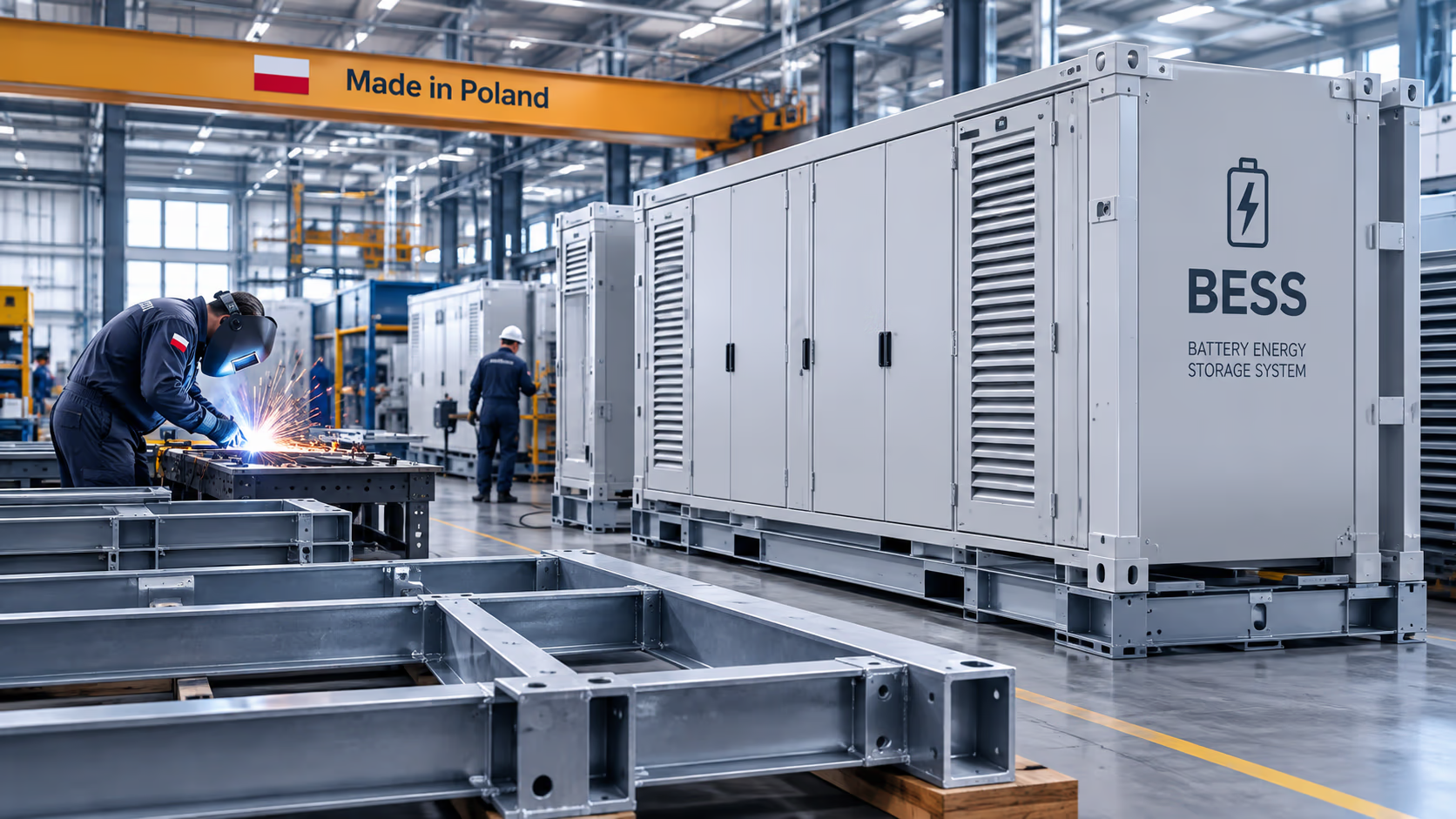
How a European integrator can qualify a Polish supplier
Qualification should not begin with a machine list. The integrator must first define whether the sourcing package concerns a PCS enclosure, a heavy skid, an auxiliary container or a partially integrated assembly, because each scope requires a different combination of processes, tests, documentation and logistics.
Initial screening and supplier shortlist
The first stage verifies processes, materials, maximum dimensions, crane capacity, certifications and relevant experience. Its purpose is to remove companies that do not meet the basic boundary conditions.
NDA and a controlled documentation package
After a non-disclosure agreement is signed, the integrator provides representative drawings, specifications, bill-of-material structure, test plan and expected volumes. The package should support a capability review without disclosing unnecessary sensitive information.
RFQ and responsibility matrix
The RFQ should separate material, design, customer-supplied components, coatings, tests, documentation, packaging and transport. Responsibility for IP, IK, EN 1090 and fire safety must be allocated to the correct party.
DFM and feasibility review
Design for manufacturing should examine material availability, bend radii, welding access, distortion, tolerances, assembly and testability. Every proposed change requires formal integrator approval.
Sample or prototype
The prototype should reproduce critical materials, welds, coatings, seals and interfaces. It also reveals the quality of documentation, response times and the supplier's approach to closing non-conformities.
Process and sub-supplier audit
The audit should cover traceability, welding, metrology, coatings, assembly and configuration control. External processes also need review if they can become quality or capacity bottlenecks.
FAI, FAT and pilot series
FAI confirms the first article, while FAT verifies the completed assembly. The pilot series tests repeatability, resource loading, packaging and closure of the punch list before shipment.
Production ramp-up and alternative-source maintenance
After a successful pilot series, the integrator increases volume while monitoring KPIs, changes and critical work centres. The supplier should provide a plan for capacity, staffing, materials, subcontractors and disruption response.
Example qualification table for an enclosure, frame and skid manufacturer
| Area | Audit question | Minimum expected evidence | Typical risk |
|---|---|---|---|
| Dimensions and internal handling | What maximum dimensions and weights can the plant machine, weld, coat and move through the complete process? | Plant layout, crane capacities, workstation dimensions, reference products and material-flow plan. | The part fits one machine but cannot move through the complete production route. |
| Materials and traceability | Does the company separate carbon steel, stainless steel and aluminium and retain traceability to the finished product? | Traceability procedure, material certificates, batch marking and warehouse records. | The link between the certificate and the part is lost after cutting or coating. |
| Welding | Do ISO 3834 scope, WPS, WPQR and personnel qualifications match the actual product? | Certificate, procedure list, welder register, inspection plan and example non-conformity report. | The certificate does not cover the material, thickness or process used in the project. |
| Coatings | Who selects and approves the protective system, and how are preparation and DFT controlled? | Coating specification, preparation report, DFT measurements and repair procedure. | The coating subcontractor cannot maintain the required documentation or throughput. |
| Sealing and assembly | Does the plant have controlled instructions for installing gaskets, doors, locks and penetrations? | Work instruction, test criteria, leak or water-test report and component identification. | A gasket change or assembly error invalidates previous test evidence. |
| IP and IK | Does the supplier understand that ratings apply to the final configuration and a defined test method? | Responsibility matrix, test report or a clearly defined support scope for the integrator. | Ratings are used in marketing without a tested configuration. |
| FAI and FAT | Can the supplier prepare a first article inspection and FAT with a punch list? | FAI template, FAT checklist, photographic report, defect register and closure evidence. | Non-conformities are found only on site, where rework is slower and more expensive. |
| Engineering changes | How are ECNs and ECRs received, approved and implemented, and how are obsolete revisions blocked? | Change workflow, revision register, implementation confirmation and configuration-traceability example. | Production uses an obsolete drawing or mixes revisions within one delivery. |
| Ramp-up | Can the company scale from prototype to 20–100 or more units without losing quality or delivery performance? | Capacity plan, staffing, material availability, critical work centres, OEE and subcontractor plan. | A successful prototype is followed by bottlenecks in welding, coating, assembly or final inspection. |
| Logistics | Does packaging address road or sea transport, corrosion in transit, centre of gravity and lifting points? | Packaging specification, lifting instruction, photographs, transport dimensions and labels. | Coating damage, deformation or unsafe unloading at the integrator's site. |
Outlook and limitations of production localisation
Poland will not replace global battery-cell manufacturers or complete BESS platform suppliers. A substantial share of storage blocks may continue to arrive from Asia as standard OEM systems with their own cooling architecture, safety package and system documentation. Some integrators operate closed approved-supplier lists and will not open critical scopes without a pilot and extended validation.
The strongest potential lies in sub-scopes where local manufacturing reduces transport, accelerates engineering changes, simplifies audits and moves rework from the construction site to the factory. This is particularly relevant for heavy skids, auxiliary structures, equipment enclosures, PCS cabinets, HVAC ducts, platforms and assembled mechanical modules. The value increases when the plant can support both prototypes and repeatable serial production.
A factory acceptance test within practical travel distance is a further advantage. The customer's team can inspect the process, close the punch list, approve packaging and return quickly for a later revision. In an intercontinental supply chain, every correction requires a larger time and cost buffer, especially when a problem is discovered only after unpacking at the site.
Localisation advantages are not automatic. The supplier must compete on total cost, including material, transport, coatings, testing, inventory, rework, service and schedule risk. Weak subcontractor control, unstable lead times or poor configuration management can eliminate the benefit of geographic proximity.
The BESS market also depends on grid connections, financing, capacity-market arrangements, permits and safety requirements that a mechanical supplier does not control. Investment in new capacity should therefore be based on a credible RFQ pipeline and equipment that can also serve other industrial sectors.
A credible strategy does not promise complete replacement of Asian imports. It identifies repeatable sub-scopes, qualifies a prototype, demonstrates process capability and gradually increases local content without compromising the integrator's architecture or intellectual property.
Summary for buyers: where metalworking creates the greatest value
Poland's energy storage market has reached a scale that justifies systematic local supplier searches. Projects under construction, capacity-market contracts, public support and the portfolios of PGE, Enea, Greenvolt and R.Power show that the opportunity extends beyond individual demonstration projects. However, assets are at different stages, so sourcing decisions should be based on verified project status rather than the size of a strategic pipeline alone.
The most realistic area for Polish companies is metalworking for the metal balance of plant: enclosures, containers, frames, skids, racks, PCS cabinets, HVAC covers, cooling components, cable routes and service structures. A supplier can begin with build-to-print and, after a successful prototype, FAI and FAT, move towards component installation and partial integration.
For the integrator, the key tasks are splitting the procurement package, allocating responsibilities correctly and assessing the complete process. ISO 9001, ISO 3834, ISO 12944, EN 1090, IP and IK serve different purposes and should not be combined into one universal requirement set. Robust qualification combines audits, process evidence, first article inspection, pilot production and a ramp-up plan.
Poland can compete not only on cost but on the relationship between cost, time and flexibility. Shorter transport, easier audits, faster engineering changes, local rework and accessible factory acceptance testing create measurable value, particularly for large, welded, coated and project-specific assemblies.
Frequently asked questions
Can a Polish metalworking company supply utility-scale BESS components without manufacturing batteries?
Yes. The most realistic localisation scope lies outside the cells, BMS and EMS. A Polish company can manufacture enclosures, technical containers, frames, skids, racks, PCS cabinets, HVAC ducts, service platforms and other metal balance-of-plant components. Value increases when the supplier also provides component installation, leak testing, first article inspection, factory acceptance testing, quality documentation and a controlled production ramp-up.
Which energy storage components are easiest to localise in Poland?
The easiest components to localise are large, welded, bent, coated and project-specific assemblies: BESS enclosures, auxiliary containers, welded bases and frames, skids, PCS cabinets, cable routes, cooling covers, platforms and barriers. Cells, modules, BMS, EMS and critical electronics are less suitable for independent localisation because they remain closely linked to the OEM's intellectual property and certification of the complete system.
Is EN 1090 required for every BESS enclosure or frame?
No. EN 1090 is relevant when the product is a structural construction product within the applicable scope of the Construction Products Regulation. Not every cabinet, cover or enclosure automatically meets these conditions. The integrator should determine the intended use, structural function and method of incorporation before setting the requirement. ISO 3834 for welding quality and ISO 9001 for the organisation's management system should be evaluated separately.
What do IP and IK mean when purchasing a BESS enclosure?
IP under IEC 60529 describes the protection provided by an enclosure against access, solid objects and water, while IK under IEC 62262 concerns resistance to mechanical impact. The ratings apply to the final configuration with doors, seals, locks, penetrations and openings. A supplier of sheet metal or an open frame should not declare them without the appropriate design, testing and clearly allocated responsibility for conformity of series production.
Which metalworking processes are commonly required for BESS components?
Typical processes include laser cutting or punching, bending, MAG and TIG welding, CNC drilling and milling, surface preparation, coating, mechanical assembly and dimensional inspection. More integrated packages may also require leak testing and installation of seals, doors, penetrations, fans and heat exchangers, together with first article inspection and factory acceptance testing. The stability of the entire process chain matters more than the availability of one machine.
How should a Polish supplier of BESS enclosures, frames and skids be qualified?
The process should include screening, an NDA, a controlled documentation package, an RFQ with a responsibility matrix, a DFM review, a prototype, an audit, first article inspection, factory acceptance testing, a pilot series and production ramp-up. Buyers should verify dimensions, materials, traceability, welding, coatings, sealing, metrology, subcontractors and logistics. Certifications are important but do not replace evidence that the actual process and configuration are stable and repeatable.
How do metalworking outsourcing and Metal Navigator support BESS sourcing?
Outsourcing can add capacity, provide specialised processes and establish an alternative EU supply source. Metal Navigator supports the first stage by narrowing Polish companies according to technology, location, certificates and business profile. It does not replace an RFQ, audit or qualification. After shortlisting, the integrator should still confirm actual dimensions, materials, available capacity, experience, testing resources and the ability to move from prototype to series production.