
Market and supply chain analysis
Tanks, Piping and Skids for Biomethane Plants in Poland: Opportunities for Technology Providers and Fabrication Partners
Poland’s biomethane market now has its first clear operational reference point: a facility connected to the gas grid. At the same time, ORLEN is developing several projects, existing biogas assets are being consolidated into larger portfolios, and public funding programmes support the construction and modernisation of biomethane plants. This does not yet amount to a broad and predictable procurement market. For companies looking for fabrication partners in Poland, the most accessible opportunity lies in the metal process infrastructure: tanks, separators, prefabricated piping, structural frames, equipment bases, access structures and skid-mounted process modules.
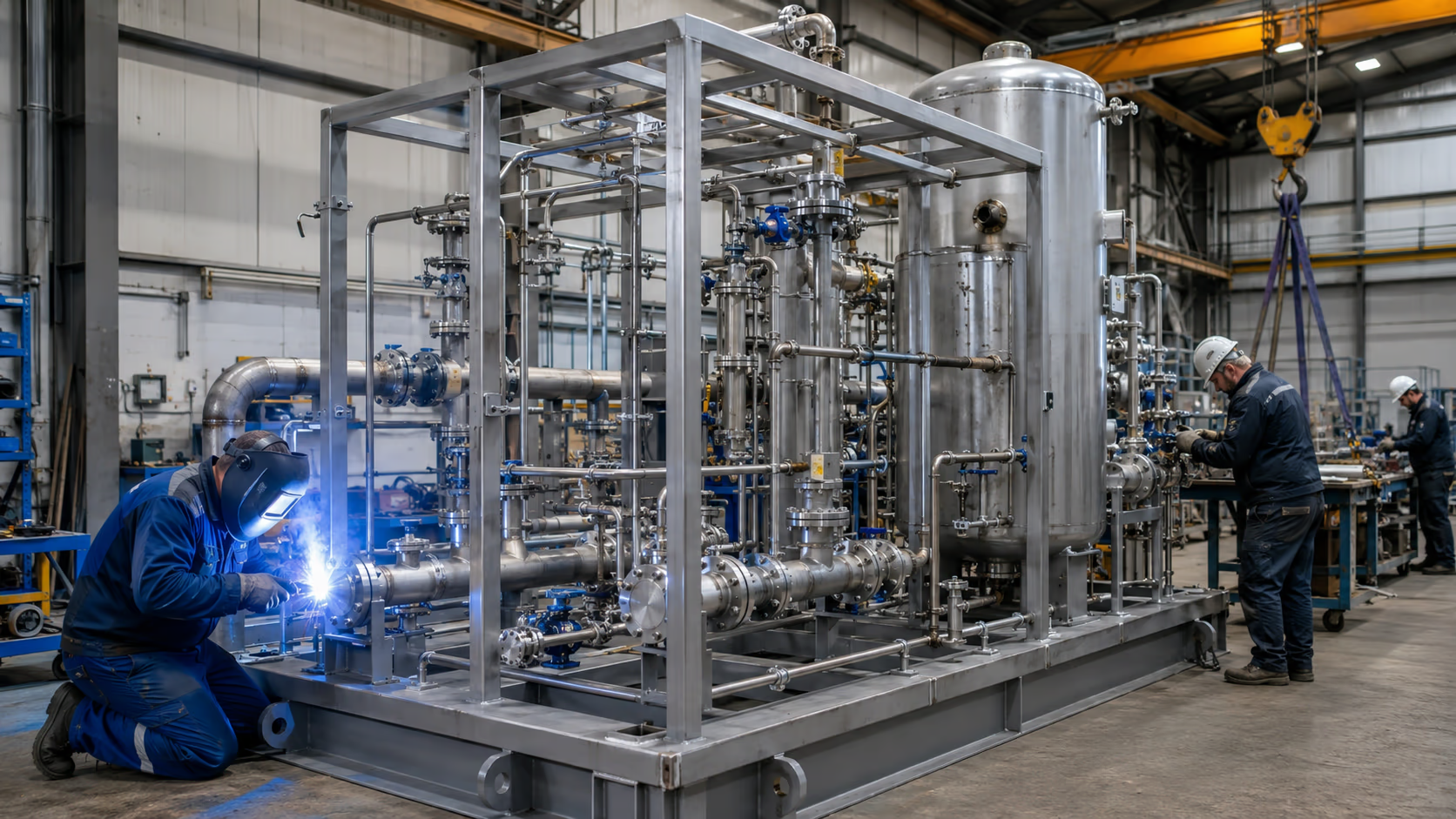
The first grid-connected plant does not yet make a mass market
The clearest evidence that the market has moved from announcements into operation is Südzucker’s installation in Strzelin. Polska Spółka Gazownictwa, Poland’s gas distribution system operator, announced on 9 September 2025 that the plant had been connected to the gas grid and described it as the first biomethane plant in Poland connected to the gas system. [6]
Biogas produced from sugar beet residues is used primarily by the sugar factory itself. After upgrading, surplus gas is injected into the network through a pipeline approximately nine kilometres long. The expanded biogas facility has a capacity of 45 MW and is capable of producing more than 9,000 m³ of biogas per hour.
Data from Krajowy Ośrodek Wsparcia Rolnictwa, the Polish National Support Centre for Agriculture, nevertheless show that domestic biomethane production remains limited. As of 28 May 2026, the register contained 209 agricultural biogas installations. Two were classified as producing biomethane, electricity and heat, but the recorded biomethane output for 2025 was only 2,500 m³. The entire volume was injected into the gas grid. [7]
Registration for a particular activity does not prove continuous production at design capacity. At least one operating plant injecting biomethane into the gas grid can be clearly identified, but the available data do not yet confirm a larger group of comparable facilities in regular operation.
Funding programmes create investment conditions, but they do not guarantee orders
Modernisation Fund biomethane programme
The first call under the programme “Poprawa bezpieczeństwa energetycznego poprzez wykorzystanie biometanu” — improving energy security through the use of biomethane — opened on 18 May 2026. Under the timetable in force on 7 August, applications were due to remain open until 18 August 2026. The programme is administered by the Narodowy Fundusz Ochrony Środowiska i Gospodarki Wodnej, Poland’s National Fund for Environmental Protection and Water Management. [1] [2]
The first call has a budget of PLN 300 million, while the programme as a whole has PLN 800 million available. Grants may cover up to 45% of eligible expenditure. Projects structured as project finance require the applicant to provide at least 15% of eligible costs from its own funds.
FEnIKS funding for businesses
A second instrument covered the development of renewable energy sources in companies. Applications were accepted between 30 January and 30 April 2026. Of the PLN 300 million total budget, PLN 200 million was allocated to biomethane installations and PLN 100 million to biogas projects. The financing was intended to combine grants and loans, with a maximum of 85% of eligible costs in project-finance structures. [3]
The closing of the application window meant only that new applications were no longer being accepted. It did not mean that funding had automatically been awarded. As of 7 August 2026, no final list of beneficiaries had been published.
Support from the Modernisation Fund is intended for businesses constructing new biomass fermentation plants equipped with a module for upgrading biogas to biomethane and a connection to the gas grid. Costs can be eligible from the date the application is submitted until 30 September 2030. The first payment cannot be made before a final building permit has been obtained, while the final environmental decision must be provided no later than before the funding agreement is signed.
These conditions reduce the likelihood of funding projects that remain at concept stage only. They do not, however, mean that the entire programme budget will translate into orders for process equipment or metal fabrication. Funding also covers civil works, fermentation systems, grid connections, automation, engineering and other investment components. Some applications may also fail during the assessment process.
For process-equipment suppliers, a signed funding agreement, the required permits, a closed financing structure and the launch of an actual procurement process are more meaningful market signals than the existence of a funding programme alone.
The regulatory environment is also still evolving. On 14 July 2026, the Polish Council of Ministers approved a draft amendment to the Renewable Energy Sources Act. The proposal includes, among other measures, an auction system for biomethane plants above 1 MW and rules governing direct pipelines for biogas and biomethane. At the date of this article, this was proposed legislation rather than an operating support mechanism. [4]
Guarantees of origin for biomethane have, however, been part of Polish legislation since 1 January 2024. [5]
Biomethane projects need to be assessed by their actual development stage
Public statements by investors provide an initial picture of the future market. They do not justify assuming that every announced facility is already being built or that procurement of tanks, skids and piping has begun.
Selected projects and confirmed status as of 7 August 2026
| Project or investor | Confirmed status as of 7 August 2026 | Potential supplier scope | Still unconfirmed |
|---|---|---|---|
| Strzelin, Südzucker | The plant is operating and was connected to the gas grid in 2025. | Gas upgrading, quality measurement, control and grid injection. | Full contract breakdown and supplier list. |
| Głąbowo, ORLEN Biometan | The facility was still described as being developed in June 2026; target capacity of 5 MW, more than 8.9 million m³ of biomethane and more than 5,000 tonnes of bioLNG per year. | Upgrading, compression, liquefaction, cryogenic systems and loading modules. | Commercial start-up, commissioning date and technology suppliers. |
| Konopnica, ORLEN | According to the investor, transformation of the existing plant is beginning; target output of up to 7.1 million m³ of biomethane per year. | Piping modernisation, gas conditioning, compression and grid-injection station. | EPC scope, timetable and awarded contracts. |
| Wojny-Wawrzyńce, ORLEN | Expansion and conversion are planned; intended output is approximately 6.8 million m³ of biomethane per year for grid injection. | Potential modernisation project based on an existing asset. | Construction start, contractors and commissioning date. |
| Buczek, ORLEN | Planned production of more than 8.9 million m³ of biomethane per year in the form of bioLNG. | Gas upgrading, liquefaction and bioLNG distribution infrastructure. | Implementation start, contracts and timetable. |
| Polska Grupa Biogazowa | 21 operating assets; since 26 September 2025 a joint venture between TotalEnergies and HitecVision. | Potential for standardised upgrades and repeatable modular packages. | List of facilities selected for conversion and scope of future tenders. |
For Głąbowo, the current project page states annual biomethane production of more than 8.9 million m³ rather than approximately 7 million m³. ORLEN plans to liquefy the gas on site and transport the resulting bioLNG by cryogenic road tankers. A June 2026 communication still described the facility as being developed. Without additional evidence, it should therefore not be presented as an operating plant or as a facility already in commissioning. [8] [9]
The same care is required when describing ORLEN’s conversion projects. The most advanced public statement relates to Konopnica, where the investor says that the transformation process is beginning. For Wojny-Wawrzyńce and Buczek, official materials refer to planned developments. Procurement procedures or signed contracts for upgrading modules covering all three sites have not been confirmed. [10] [11] [12]
The same distinction applies to Polska Grupa Biogazowa. In May 2025, TotalEnergies agreed to sell a 50% stake to HitecVision, valuing the business at EUR 190 million. The transaction closed on 26 September 2025. The EUR 190 million figure is therefore an enterprise valuation used for the transaction, not a construction budget for new biomethane plants. [13] [14]
The stated ambition to reach production of 2 TWh per year by 2030 may include new projects, upgrades and acquisitions. It is not a list of approved investments and should not be interpreted as the value of confirmed orders for process-equipment manufacturers.
A funding programme budget, a submitted application, an enterprise valuation, an announced plant conversion and a production target all describe different events. None of them, on its own, proves that procurement of metal process equipment has started.
Most metal process equipment appears downstream of fermentation
Biogas produced by anaerobic digestion contains methane, CO₂, water vapour and H₂S. Depending on the feedstock, it may also contain ammonia, oxygen, nitrogen, particulate matter and siloxanes. To produce biomethane, CO₂ and contaminants must be removed and the gas brought to the quality required for grid injection or for the production of bioCNG or bioLNG. [17]
The highest concentration of metal process equipment generally begins at the raw-biogas take-off point. The gas is cooled and dewatered, with condensate removed in separators. H₂S, particulates and other contaminants are then removed. Depending on the process, CO₂ may be separated using membranes, pressure swing adsorption, water scrubbing or chemical absorption.
After upgrading, the gas is compressed, analysed for quality and regulated for pressure and flow. Depending on the specification, adjustment of the calorific value may also be required. The biomethane is then injected into the gas grid or sent to a bioCNG or bioLNG system.
This does not mean that an entire biomethane plant represents a market for steel tank manufacturers. Digesters in large facilities are often reinforced-concrete structures. Steel may instead be used for roofs, nozzles, frames, platforms, supports and process equipment. The share of metal components depends on the selected technology, plant size, ground conditions and project delivery model.
Local fabrication potential and capabilities that need to be verified
| Plant area | Typical scope suitable for local fabrication | Capabilities to verify |
|---|---|---|
| Raw-gas conditioning | Condensate separators, filters, desulphurisation vessels, manifolds, drains and condensate lines. | Leak tightness, resistance to condensate composition, maintenance access and non-destructive testing. |
| Gas-upgrading module | Skid frame, piping, enclosures, supports, auxiliary vessels and valve installation. | Fabrication to P&ID, 3D model and traceability requirements. |
| Compression and grid injection | Compressor bases, manifolds, buffer vessels, metering modules and station enclosures. | Vibration, dynamic loading, pressure, metering requirements and access to valves. |
| BioCNG and bioLNG | Frames, piping, guards, platforms, loading modules and support structures for cryogenic equipment. | Design temperature, thermal contraction, insulation, cleanliness requirements during assembly and testing. |
| Process and pressure vessels | Adsorbers, filter vessels, buffers, separators and heat-exchanger shells. | Engineering calculations, applicable PED requirements, NDT and pressure testing. |
| Auxiliary steelwork | Flare structures, platforms, stairs, pipe supports, containers and enclosures. | Loads, weather exposure and EN 1090 where applicable. |
| Digestion and digestate handling | Steel roofs, shafts, hubs, pins, mixer components and frames for separation equipment. | Fatigue, wear, chemical resistance, geometry and balancing. |
Stainless-steel process piping, skid frames, compressor bases, condensate separators, auxiliary tanks, containers, platforms and valve modules are particularly suitable for local prefabrication. A fabrication partner can also procure valves, heat exchangers, pumps or instruments specified by the integrator, mount them on the skid and carry out a Factory Acceptance Test (FAT).
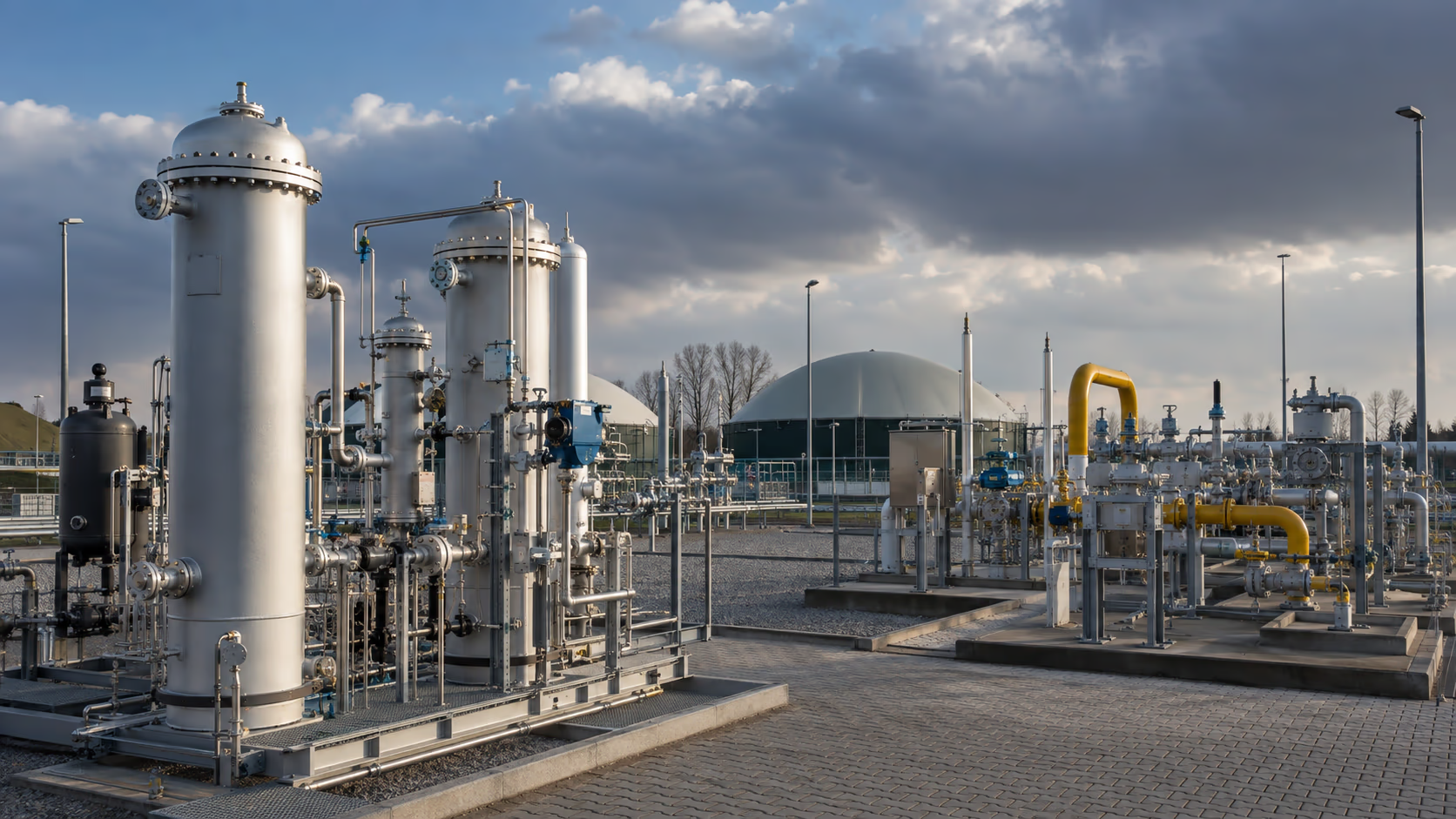
The process technology can remain foreign while the mechanical package is built in Poland
The technology provider will typically retain ownership of process calculations, mass balances, guaranteed performance parameters, control philosophy, membrane selection and configuration, sorbent formulations, column internals, software and algorithms designed to minimise methane slip. In bioLNG projects, this also applies to specialised cryogenic systems. Compressors, analysers and other equipment with a direct impact on process guarantees may also remain within the technology provider’s own scope.
A Polish fabrication partner can take responsibility for the surrounding mechanical infrastructure: frames, vessels, piping, supports, enclosures, platforms, transport structures and the integration of bought-in equipment. The boundary of local fabrication depends on the integrator’s procurement policy, intellectual-property protection and the allocation of warranty and performance responsibility.
Build-to-print fabrication
In the basic model, the foreign technology provider supplies approved fabrication drawings and the Polish company manufactures clearly defined components and assemblies to that documentation.
Mechanically complete skid
A broader model can include the transfer of a 3D model, material specifications, valve lists, welding requirements and an inspection and test plan. On this basis, the local partner delivers a mechanically complete skid package.
The scope can be extended to testing, packing, delivery, site piping installation and commissioning support. Before doing so, the parties need to establish who is the manufacturer of the assembly for PED purposes, who issues the EU Declaration of Conformity, who is responsible for selecting components intended for potentially explosive atmospheres and who has authority to approve deviations from the released documentation.
Once the supply boundaries and responsibilities have been defined, an initial shortlist can be built using Metal Navigator, the search tool for metalworking and fabrication suppliers in Poland. It can help narrow the field by manufacturing processes and selected standards, but it does not replace reference checks, technical prequalification or a supplier audit.
Materials should be selected for the medium, not simply for the type of plant
Wet biogas affects materials differently from dry air or ordinary process water. Water vapour condenses in colder parts of the system, while CO₂ and H₂S can contribute to the formation of aggressive condensate. Ammonia, chlorides, temperature, pressure, periods of shutdown and cleaning chemicals can also influence corrosion behaviour.
For this reason, specifying 316L as the default material for an entire biomethane plant is not a sound engineering approach. Coated carbon steel may be sufficient in dry and less corrosive parts of the installation. Elsewhere, 304L, 316L, duplex grades or more highly alloyed materials may be appropriate. The decision should follow an assessment of the gas and liquid composition, temperature, pressure, shutdown conditions and process specification.
A single blanket material specification for the entire plant can either drive unnecessary cost or provide inadequate resistance in areas exposed to aggressive condensate or particularly demanding operating conditions.
Fabricating vessel shells requires plate rolling, an appropriate welding sequence and effective distortion control. TIG and orbital welding can be used for stainless-steel piping, particularly where there is a high number of repeatable joints. MAG welding is typical for frames, bases and support structures, while submerged arc welding may be suitable for larger vessel shells and long weld seams.
Special flanges, mixer shafts, hubs and fastening components can require CNC machining. Welded stainless-steel components may require pickling and passivation. Carbon steel, by contrast, requires suitable surface preparation and a coating system selected for the intended operating environment.
PED, ATEX, EN 1090 and ISO 3834 address different requirements
Pressure equipment and piping
The Pressure Equipment Directive 2014/68/EU applies to the design, manufacture and conformity assessment of pressure equipment and assemblies with a maximum allowable pressure generally greater than 0.5 bar. The applicable procedure depends, among other factors, on the type of equipment, fluid group, pressure, volume or nominal diameter and the category of the product. [18]
Not every tank, pipeline or skid therefore follows the same conformity route. It also matters whether the manufacturer supplies an individual item of pressure equipment or a complete assembly. Involvement of a Notified Body follows from the selected conformity-assessment module, not simply from the fact that a component will be installed in a biomethane plant.
EN 13445 covers unfired pressure vessels and can be one route to demonstrating compliance with PED requirements. It is not, however, a universal standard for atmospheric tanks, digesters and every type of separator. [21]
The EN 13480 series covers metallic industrial piping. It should not automatically be applied to an external gas pipeline, which may be subject to separate legislation and the requirements of the relevant gas network operator. [22]
Explosion protection
In potentially explosive atmospheres, product requirements need to be distinguished from the duties of the plant designer and operator. Directive 2014/34/EU applies to equipment and protective systems intended for use in potentially explosive atmospheres. Directive 1999/92/EC addresses the responsibilities of employers and plant operators, including risk assessment and hazardous-area classification. [19] [20]
A passive steel skid frame therefore has a different status from a complete module containing motors, solenoid valves, heaters, sensors, analysers and control panels. There is no single universal “ATEX certificate” that establishes the safety of an entire biomethane plant without considering the actual equipment, hazardous zones and potential ignition sources.
Structural steelwork and welding quality
EN 1090 applies where a product is a structural construction component within the scope of the standard and affects the load-bearing capacity or stability of a structure. It does not automatically apply to every vessel, manifold or process skid. [23]
ISO 3834 sets quality requirements for fusion welding of metallic materials in the workshop and during site installation. It does not replace PED, qualification of a specific welding procedure, project-specific manufacturing documentation or an inspection and test plan. [24]
A blanket requirement for “PED, ATEX, EN 1090 and ISO 3834” without identifying which requirements apply to which components often results in suppliers pricing against different assumptions. Properly separating these areas directly affects responsibility, documentation, price and project schedule.
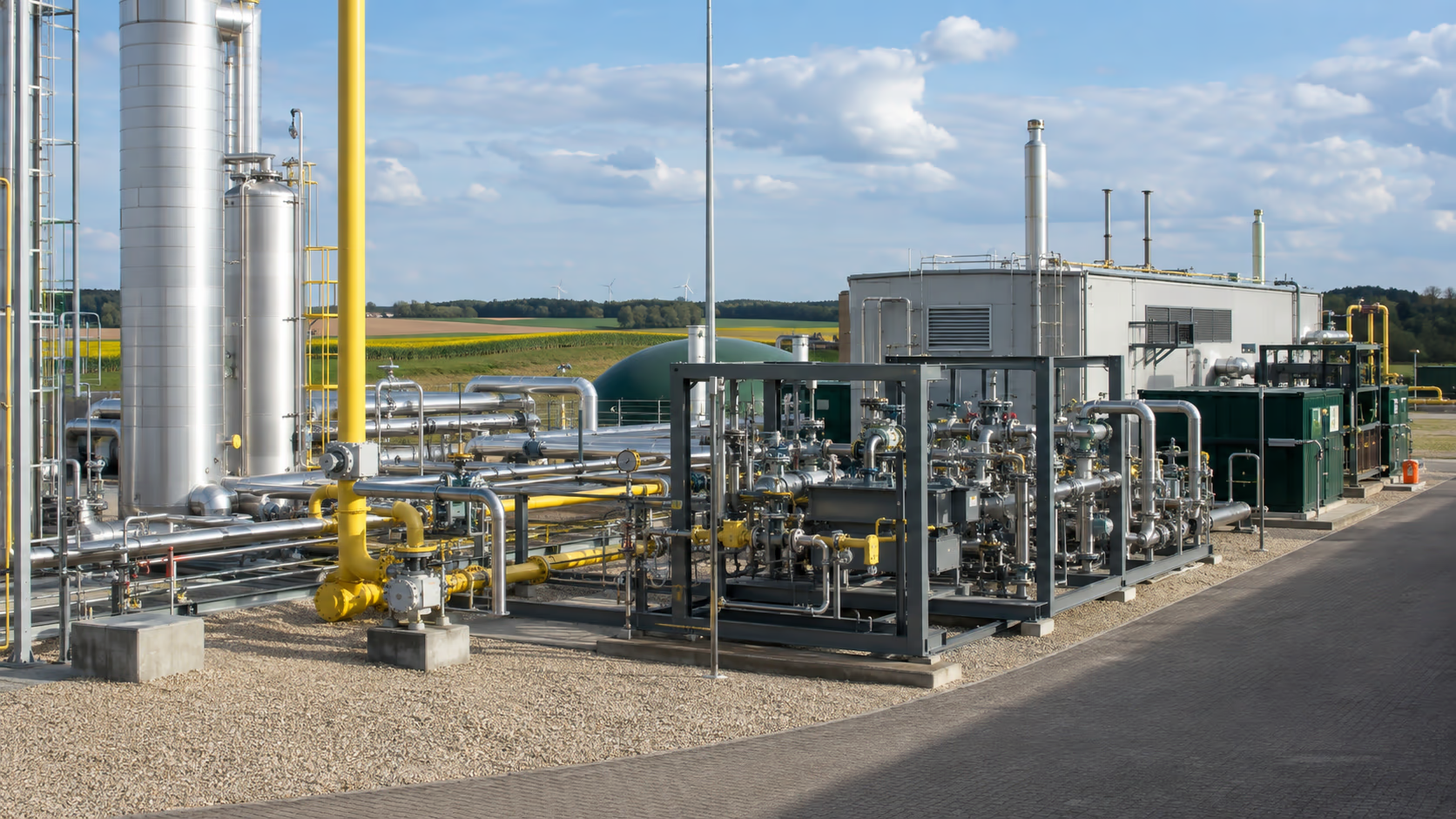
A skid supplier needs to offer more than competent welding
A statement that a company fabricates stainless-steel structures does not prove that it can prefabricate gas process systems. A suitable manufacturer should be able to demonstrate references from chemical processing, gas, food, energy or environmental applications. Experience in building halls and straightforward steel structures is not equivalent to experience with pressure equipment and process installations.
Areas to verify include:
- welding procedure specifications (WPS) and supporting welding procedure qualification records (WPQR);
- qualifications of welders and welding coordination personnel;
- material certificates and traceability of heat numbers;
- inspection and test plan;
- scope and qualification of non-destructive testing;
- facilities for pressure and leak testing;
- organisation of stainless-steel production and separation from carbon-steel processing;
- pickling, passivation and other surface-treatment capabilities;
- as-built documentation in the language required by the customer.
A plant capable of supplying a complete mechanical package has a clear advantage. Such a package may include the frame, vessels, piping, bought-in valves and fittings, supports, guards, insulation, equipment installation, testing and transport protection. For some projects, the scope may also extend to site installation.
The manufacturer should also be prepared to build a first unit, implement changes following the FAT and then reproduce the module consistently for subsequent projects. For a technology owner, the relevant consideration is therefore not only the price of the prototype, but also whether the supplier can maintain quality and documentation standards as volumes increase.
A well-structured RFQ reduces the risk of deceptively low quotations
The division of responsibilities should be established before the request for quotation is issued. The foreign technology provider may retain responsibility for process design criteria, mass balances, guaranteed performance, control philosophy, P&IDs and specialist equipment. The plant designer can then be responsible for layout, hazardous-area classification, connection calculations and infrastructure interfaces, while the fabrication partner manufactures the approved components and assemblies.
A technical RFQ should contain at least five groups of information:
1. Process data
Design and operating parameters, composition of the gas and condensate, temperatures, pressures, cleaning methods and material requirements.
2. Battery limits and supply scope
Scope of frames, vessels, piping, structures, enclosures, bought-in valves, insulation, auxiliary wiring and site work.
3. Regulatory and quality requirements
Applicable PED and ATEX requirements, relevant standards, welding requirements, required level of traceability and responsibility for marking and declarations of conformity.
4. Inspection and acceptance
Extent of NDT, test methods, FAT criteria, dimensional inspection, content of as-built documentation and rules for approving deviations.
5. Transport and installation
Maximum dimensions, module split, lifting points, transport protection, storage conditions and the required level of commissioning support on site.
Without this information, quotations can be difficult to compare. A price difference may reflect not a supplier’s productivity, but different assumptions about battery limits, materials, testing requirements or responsibility for conformity.
From a longlist to a qualified fabrication partner
The supplier-selection process should not end with finding a company that simply lists the required manufacturing processes on its website. A practical qualification process can follow these steps:
Define the supply boundaries
Establish the process parameters, mechanical scope and division of responsibility between the technology provider, engineering company and fabricator.
Allocate the requirements
Assign PED, ATEX, welding and documentation requirements to the specific equipment, piping, structures and assemblies to which they apply.
Protect confidentiality and create a longlist
Put a confidentiality agreement in place and identify potential manufacturers capable of covering the basic fabrication scope.
Review documents and references
Assess experience with process systems, welding qualifications and samples of fabrication, inspection and handover documentation.
Prequalify technically and issue the RFQ
Carry out a technical screening and issue a comparable request for quotation only to suppliers that meet the entry requirements.
Audit the plant and subcontractors
Review the production organisation, quality-control system, equipment, material flow and processes outsourced to subcontractors.
Build the first unit or prototype
Use the first module to validate documentation, workmanship, communication and the supplier’s ability to implement agreed changes in a controlled manner.
Conduct FAT and review final documentation
Carry out the agreed Factory Acceptance Test and verify the completeness of quality records and final handover documentation.
Approve the supplier for repeat production
Decide whether to qualify the company for subsequent modules based on the first-unit results and its ability to maintain the required standard consistently.
The key barriers are project-related, grid-related and organisational
The rate of market development can be constrained by the available grid injection capacity in a particular area. Polska Spółka Gazownictwa indicates that the amount of biomethane that can be injected depends on the ability of the relevant grid zone to accept the gas. Where local capacity is insufficient, possible solutions may include compression into a higher-pressure network, connecting separate grid zones or transporting the gas as bioCNG or bioLNG — sometimes described as a virtual pipeline. [15]
The grid-injection system must allow both gas quantity and gas quality to be monitored. It also needs a solution for stopping and returning product that fails to meet the required specification. For equipment suppliers, this creates additional demand for metering modules, isolation valves, pressure and flow control systems, analysers and bypass piping. [16]
Other risks include feedstock availability, environmental decisions, building permits, local opposition and the investor’s financing capacity. Parts of the core technology may arrive as fully packaged modules, while intellectual-property protection can limit the scope available for local fabrication. Digesters will not necessarily be fabricated in steel, and procurement may be consolidated centrally by a foreign integrator.
The final share of work awarded to a Polish fabricator therefore depends on the EPC model, the technology owner’s procurement strategy and its willingness to separate the mechanical package from its standard technology scope.
Conclusions for investors and manufacturers
The most credible opportunities are likely to arise from conversions of operating biogas plants and from projects that already have permits, secured financing and a clearly defined route for selling or injecting the biomethane. A high share of metal process equipment is concentrated in gas upgrading, compression, grid injection and bioCNG or bioLNG systems.
For Polish fabrication companies, the most accessible packages include piping, auxiliary and pressure vessels, separators, skid structures, equipment bases, containers and mechanical assembly. Components tied directly to the technology provider’s intellectual property are more difficult to localise. These can include membranes, specialised compressors, analysers, cryogenic systems, software and process guarantees.
A foreign investor or integrator should therefore define the supply and responsibility boundaries precisely before creating a shortlist of potential contractors. Companies sourcing tanks, piping and skids for biomethane plants in Poland need to assess not only fabrication capability, but also the supplier’s ability to work with process documentation, materials selected for corrosive media, PED and ATEX requirements and a demanding inspection and handover package.
Poland’s biomethane sector can create recurring demand for metal fabrication, but the size of that opportunity will not be determined simply by the number of announced projects. Orders will depend on permits, financing, grid access, the investor’s procurement model and the ability of suppliers to take responsibility for a complete mechanical package.
Frequently asked questions
Which parts of a biomethane plant can be manufactured in Poland?
Local suppliers can manufacture process and pressure vessels, condensate separators, stainless-steel piping, valve manifolds, skid frames, compressor bases, containers, platforms, supports and enclosures. A Polish fabricator can also integrate valves, heat exchangers, pumps and instruments specified by the technology provider. Membranes, specialised compressors, analysers, cryogenic systems and software are more likely to remain within the technology owner’s scope.
Does every tank in a biomethane plant fall under PED?
No. PED generally applies to pressure equipment and assemblies with a maximum allowable pressure above 0.5 bar. The detailed classification depends on factors such as the fluid, pressure, volume, design and function. An atmospheric tank, a low-pressure separator and a compressed-biomethane buffer vessel can therefore be subject to different requirements.
Does every process skid have to comply with ATEX requirements?
Not in the same way. A passive steel frame presents a different compliance profile from a complete skid containing motors, sensors, solenoid valves, analysers and control panels. The applicable requirements depend on hazardous-area classification, the equipment installed and potential ignition sources. Product-manufacturer responsibilities also need to be distinguished from the obligations of the plant designer and operator.
Which steels are used for piping in biomethane plants?
Coated carbon steel may be suitable for dry and less corrosive media. Stainless grades such as 304L or 316L can be considered for wet biogas, condensate and parts of the gas-upgrading system. Higher chloride levels, aggressive chemistry or demanding temperature conditions may require duplex or more highly alloyed grades. There is no single material that is appropriate for every part of the plant.
How should a Polish manufacturer of tanks and skids be qualified?
The first step is to verify references from process installations rather than relying only on experience with general steel structures. An audit should cover welding qualifications, material traceability, NDT, test capabilities, the organisation of stainless-steel production and experience with PED. For a new supplier relationship, manufacturing a first unit followed by an agreed FAT can provide an additional qualification step.
Does the budget of a funding programme equal the value of future supplier contracts?
No. Funding programmes cover many cost categories, including civil works, fermentation, grid connections, automation and engineering, and some applications may not pass the assessment process. For suppliers, signed funding agreements, permits, secured financing and actual procurement procedures are much more meaningful indicators.