
28 September 2026
Used Clothing from Canada — an Additional Supply Source for Importers and Sorting Facilities
Do you import unsorted used clothing from Europe or the US and are you looking for another source of supply? Canada can complement your existing purchasing without replacing established suppliers. A first container allows you to compare a Canadian shipment with the goods you already know — in terms of saleable yield, sorting costs and sales to your customers.

Canada alongside your current suppliers
An additional sourcing market can address a specific need: supplementing deliveries to your own retail network, broadening the range for wholesale customers, or developing a category that customers are requesting more frequently. This does not require a complete change to your sourcing model. You can begin with a single shipment and use the results to assess whether there is scope for further orders.
Your current purchases remain the benchmark. If you have customers for seasonal clothing, denim or sportswear, what will matter most is whether these categories can be separated out and how the remainder of the shipment performs in sales. The country of origin alone does not determine quality or commercial viability. What matters is the specific supplier, the source of the collection and what actually goes into the container.
Goods you can sort for your own customers
The Canadian supplier we work with offers “Canadian sourced credential” — unsorted used clothing sourced on the Canadian market and intended for further sorting. For a company with its own sorting facilities, this means being able to create its own categories, quality grades and pack sizes rather than adapting sales to a ready-made classification imposed by the supplier.
If you supply shops for the autumn-winter season, jackets, coats, jumpers and fleeces can be used to prepare separate seasonal lots. For customers specialising in sportswear or outdoor clothing, suitably selected sweatshirts, trousers and jackets may form an interesting category. However, an item’s condition, material and workmanship — not its Canadian origin — determine which grade it belongs to.

Denim and styles suited to a vintage range can be handled differently. For online shops and customers selling individual items, smaller, more carefully selected packs may be an option. Children’s clothing, in turn, can be prepared in lots by size, season and quality — provided that this is the type of classification your customers need.
These are examples of how the assortment can be used, not a declaration of the composition of a Canadian shipment or a guarantee of the proportion represented by individual categories.
In-house sorting makes it possible to combine several sales channels: selected pieces for retail and online customers, lots for shops selling by weight, and stock for wholesalers. The most important factor is to match the classification to actual orders and sales opportunities. A few attractive individual items do not in themselves determine the value of the purchase as a whole.
First container: comparison with your current purchases
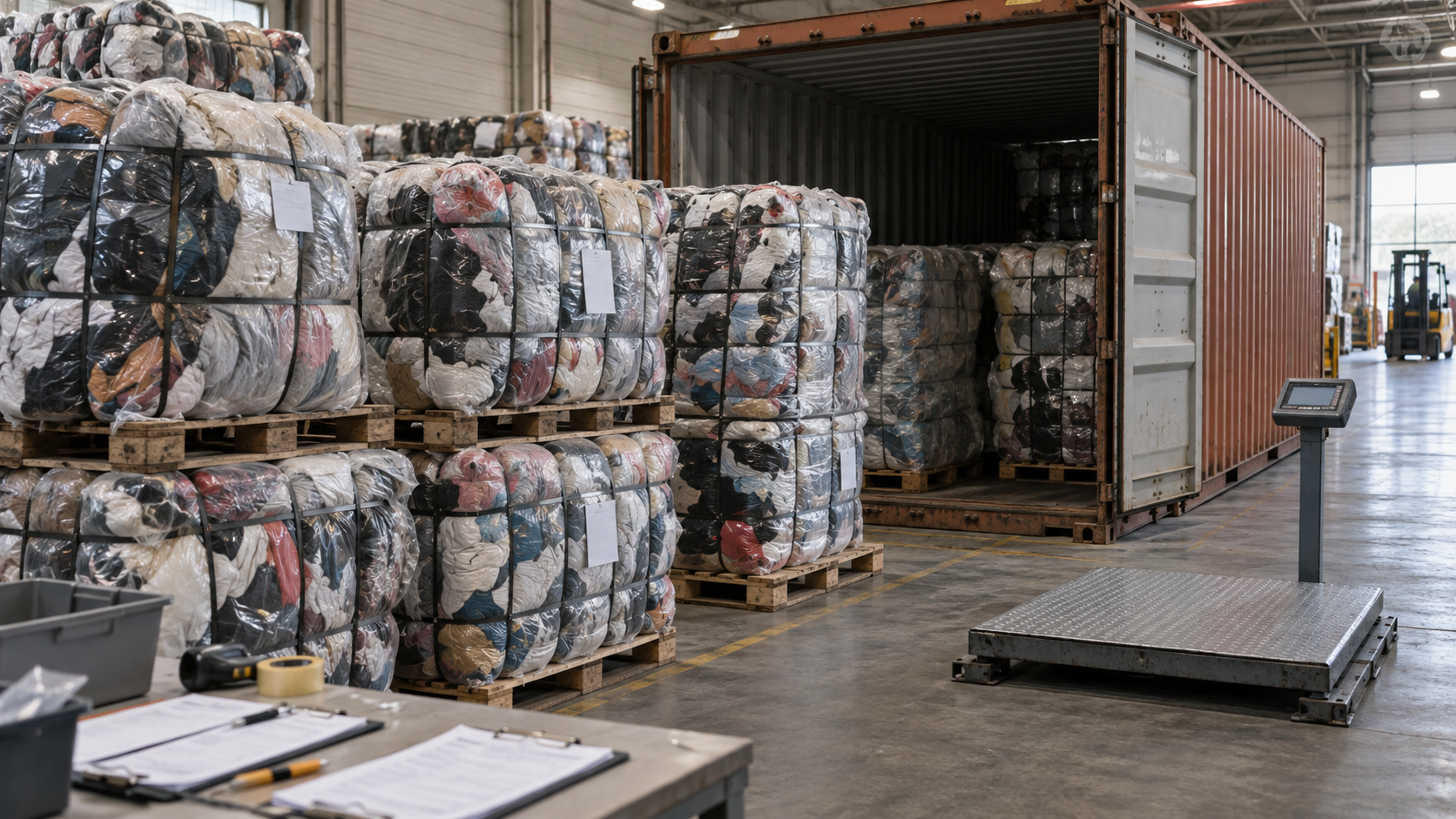
For a trial shipment, we propose a 20-foot container with approximately 10,300 kg of goods. The indicative preparation time is 2–3 weeks from order confirmation, while sea transport to a Polish seaport takes approximately 25 days. These are two separate stages: the approximately 25 days refers to sea transit to the Polish port, not the final delivery time to the buyer. The arrival date must be confirmed for each specific shipment. If you are interested, Target Solutions will provide the specific transit and delivery timing for the relevant destination country and shipment.
A shipment of this size provides a basis for comparing the new source with suppliers you already work with. Applying the same sorting criteria will show how much stock falls into the individual grades and categories, how much work is required to prepare it, and what selling prices can be achieved. Sales time is also important — especially where part of the assortment is seasonal.
What to assess with the first shipment
- Saleable yield — the kilograms and percentage share of clothing suitable for sale in the individual categories.
- Residual material — the proportion of material that cannot be sold as clothing and the method and cost of handling it.
- Labour input — the time required for sorting, repacking and preparing the goods for resale.
- Selling prices — the actual prices achieved for the separated categories, not just for the best individual pieces.
- Stock turnover — the time required to sell the shipment and the period for which it occupies warehouse space.
Let’s discuss delivery to your business
Our company supports communication with the exporter, negotiations and organisation of the sales process. We act as an intermediary, not as the seller or a party to the sales contract. The contract is concluded between the exporter and the buyer. The exporter accepts the order, issues the sales documents and handles the payment.
If you import unsorted used clothing and want to compare Canadian goods with your current supply, contact us.
FAQ — used clothing from Canada
What is “Canadian sourced credential”?
“Canadian sourced credential” is unsorted used clothing offered by the supplier we work with, sourced on the Canadian market and intended for further sorting.
Does Canadian origin guarantee the quality of the clothing?
No. The country of origin alone does not determine quality or commercial viability. What matters is the specific supplier, the source of the collection and what actually goes into the container. An item’s condition, material and workmanship — not its Canadian origin — determine which grade it belongs to.
What does the proposed trial shipment contain?
For a trial shipment, we propose a 20-foot container with approximately 10,300 kg of goods.
How should the first shipment be assessed?
Compare the saleable yield, the proportion and handling cost of residual material, the labour required for sorting and repacking, the actual selling prices achieved for the separated categories, and stock turnover — the time required to sell the shipment and the period for which it occupies warehouse space.
How long do preparation and transport take?
The indicative preparation time is 2–3 weeks from order confirmation, while sea transport to a Polish seaport takes approximately 25 days. These are two separate stages: the approximately 25 days refers to sea transit to the Polish port, not the final delivery time to the buyer. The arrival date must be confirmed for each specific shipment. If you are interested, Target Solutions will provide the specific transit and delivery timing for the relevant destination country and shipment.
What is Target Solutions’ role in the delivery process?
Target Solutions supports communication with the exporter, negotiations and organisation of the sales process. It acts as an intermediary, not as the seller or a party to the sales contract. The contract is concluded between the exporter and the buyer. The exporter accepts the order, issues the sales documents and handles the payment.