
Energy infrastructure and metalworking
Transformer Tank Manufacturers in Poland: Substation Structures and Switchgear Enclosures for Grid Modernisation
Modernisation of Poland’s electricity network is creating long-term demand for transformers, switchgear, control cabinets and metal components manufactured to customer documentation. This analysis identifies where real orders arise, how to distinguish a specialist transformer tank manufacturer in Poland from a general welded-fabrication company, and how to qualify a new supply source.
Investment scale and status of the PSE plans
The development plan of Polskie Sieci Elektroenergetyczne for 2025–2034, approved by the President of Poland’s Energy Regulatory Office, provides for PLN 66 billion of investment, approximately 4,700 km of new 400 kV circuits, 28 new substations and the extension or modernisation of around 110 existing sites. The document was approved in December 2024 and remained the binding plan at the reporting date. [2]
The next edition, presented on 2 February 2026 as the “Development plan for meeting present and future electricity demand for 2027–2036”, also assumes approximately PLN 66 billion. It covers 5,000 km of new 400 kV circuits, 30 new substations and the extension or modernisation of 110 existing sites. Circuit kilometres should not automatically be treated as route kilometres, particularly for multi-circuit lines. [1]
Consultation on the 2027–2036 draft ended on 23 February 2026, after which PSE published a post-consultation version. As of 3 August 2026, PSE still described the document as a draft, and the source material reviewed for this article did not contain an official announcement of its approval by the President of URE. It should therefore not be presented as an approved plan. [1]
The scale of the plans does not mean that PLN 66 billion will flow to transformer manufacturers, still less to suppliers of tanks, frames and enclosures. The budgets cover the complete investment process: property acquisition, engineering, foundations and buildings, conductors and cables, primary equipment, automation, telecommunications, installation, commissioning and services. For metalworking companies, the relevant factor is the recurring substation programme and the pressure on equipment producers to expand capacity or establish alternative sources.
No reliable public data is available to calculate the Polish market value of transformer tanks, switchgear enclosures and substation structures alone, or the market shares of manufacturers in this narrow segment. Network-operator expenditure should not be treated as the market directly accessible to metal subcontractors.
Market and order segmentation
The market for electricity-network equipment and components is not a single, easily measurable segment. It includes the 400 kV and 220 kV transmission network, 110 kV distribution networks, medium- and low-voltage networks, complete transformers and switchgear, substation automation and a broad range of welded structures, enclosures and machined parts. Voltage level, equipment type, technical responsibility and procurement route all matter.
Market segments and demand characteristics
| Segment | Typical equipment or components | Direct customer | Demand characteristics |
|---|---|---|---|
| Transmission network | Tanks for large transformers, autotransformers and reactors; bases, equipment structures, gantries and platforms | Equipment manufacturer, integrator or main contractor | Low volumes, large dimensions and extensive acceptance requirements |
| 110 kV networks | HV/MV transformers, outdoor and indoor switchgear, protection cabinets and bay structures | Equipment manufacturer and substation contractor | One-off projects and repeatable configurations |
| Medium-voltage networks | Switchgear enclosures, containerised substations, cabinets, cable trays, bases and frames | Switchgear or substation manufacturer | Higher repeatability, standardisation and delivery pressure |
| Distribution transformers | Corrugated tanks, covers, frames, radiators and conservators | Transformer manufacturer | Series production, high repeatability and leak control |
| Substation automation | Control, protection and telecommunications cabinets and mounting plates | Automation integrator | Project-specific configurations and frequent documentation changes |
| Auxiliary structures | Platforms, stairs, guardrails, supports, cable routes and covers | Integrator, construction contractor or equipment manufacturer | Fragmented market and easier establishment of a second source |
Public statistics do not separately report the value of outsourced tank and enclosure manufacturing. Global transformer, switchgear and automation producers compete in the final-equipment segment, while the market for metal components is distributed among specialist fabricators, manufacturers retaining some processes in-house and subcontractors for special processes.
Participants in the metal-component supply chain
| Participant group | Business model | Advantage | Limitation | Public market share |
|---|---|---|---|---|
| Transformer manufacturers | Design and sale of complete equipment; some structures produced internally and some outsourced | Own product documentation and responsibility for transformer performance | Long lead times and the need to secure production capacity | No data for metal components |
| Switchgear and apparatus manufacturers | Catalogue products and project-specific configurations | Equipment testing, standardisation and access to network operators | The enclosure must conform to the complete equipment system | No data |
| Integrators and turnkey contractors | Engineering, supply, installation and commissioning of substations | Integration of packages from multiple manufacturers | High schedule and contractual responsibility | No data |
| Specialist fabrication companies | Tanks, frames, enclosures or structures manufactured to customer documentation | Focus on metalworking processes | Dependence on customer documentation and qualification | No data |
| Special-process subcontractors | Galvanising, painting, testing and machining | Specialised infrastructure | Transport, queue and divided-responsibility risks | No data |
Multi-year investment cycle
Transmission demand is being driven by new 400 kV corridors, power evacuation from northern Poland, connections for offshore wind farms and the nuclear power plant, a planned north–south HVDC link and the modernisation of older substations. PSE reports that 53% of overhead lines and 61% of substations are more than 40 years old. Equipment replacement is therefore driven both by the changing geography of generation and by the age of existing assets. [1] [3]
Distribution investment is more dispersed. It includes 110 kV networks, primary substations, MV/LV substations, line cabling, automation, voltage-regulation systems and smart meters. The agreed plans of the five largest distribution system operators for 2023–2028 increased from PLN 42 billion to approximately PLN 72 billion compared with the preceding perspective. [2]
Capital expenditure by the five largest distribution system operators
| Year | Expenditure | Data type | Interpretation |
|---|---|---|---|
| 2021 | PLN 7.2bn | Actual | Reference point before the investment acceleration |
| 2022 | PLN 9.4bn | Actual | Clear annual increase |
| 2023 | PLN 11.7bn | Actual | Further expansion of investment |
| 2024 | Almost PLN 12.5bn | Actual | Highest actual value in the comparison |
| 2025 | PLN 12.74bn | Agreed plan | Should not be presented as actual expenditure |
The increase is not caused solely by renewable-energy connections. Networks must also serve energy storage, industrial electrification, new residential development, charging infrastructure and data centres. Stoen Operator reported that connected and planned data centres in Warsaw require almost 500 MW and that demand may at least double within a decade. This is the operator’s forecast for its own service area, not a national statistic. [8]
Programmes with financing, completed work or a confirmed project portfolio
| Programme or investor | Period | Value or scope | Lines and substations | Status | Significance for metal components |
|---|---|---|---|---|---|
| PSE plan 2025–2034 | 2025–2034 | PLN 66bn | Approximately 4,700 km of 400 kV circuits; 28 new substations; around 110 modernised | Approved by the President of URE in December 2024 | Transformers, reactors, apparatus, substation structures, cabinets and platforms [2] |
| PSE draft 2027–2036 | 2027–2036 | Approximately PLN 66bn | 5,000 km of 400 kV circuits; 30 new substations; 110 modernised | Post-consultation draft | Directional portfolio of future orders; scope may change [1] |
| PGE Dystrybucja, seven National Recovery Plan projects | According to contractual deadlines | Projects worth almost PLN 2.3bn; support of nearly PLN 1.4bn | Construction or reconstruction of 504 substations at all voltage levels, more than 177 km of lines and nearly 58,000 meters | Financing agreements signed; all seven projects belong to PGE Dystrybucja | Substations, transformers, enclosures, cabinets and installation components [4] |
| Enea Operator, rural areas | To June 2026 according to the source communication | Approximately PLN 1.53bn net; grant of around PLN 1.15bn | Approximately 450 km of lines and more than 6,500 substations at all voltage levels | Financing agreement signed | Large number of MV/LV substations, transformer replacement and digitalisation [5] |
| TAURON Dystrybucja | Multi-year | National Recovery Plan loan increased to almost PLN 15bn; PLN 310m for digitalisation | New and modernised HV/MV substations and MV networks | Financing signed; procurement procedures under way | 110/20 kV and 110/15 kV substations, switchgear, structures and cabinets [6] |
| Energa-Operator | To 2035 | Programme of approximately PLN 40bn; PLN 7.5bn from the National Recovery Plan and PLN 3.5bn from the EIB | More than 11,000 km of new lines and nearly 10,000 km modernised; at least 50 new primary substations | Long-term programme with part of the financing signed | Approximately 1,000 transformers and voltage-regulation devices [7] |
| Stoen Operator | 2024 and subsequent years | PLN 650m spent in 2024; further grants and projects | HV and MV cable projects and primary-substation modernisation | Actual expenditure and contracted projects | Indoor switchgear, cabinets, enclosures and structures for urban sites [8] |
TAURON reported that in 2025 it built 2,432 km of new lines, modernised 692 km, constructed 447 MV/LV substations and modernised 425. It also connected more than 700 MW of renewable generation and 100 MW of battery storage. These are implementation results rather than plans. The procurement schedule for the second half of 2026 included the Wysoki Brzeg, Rębielice, Halemba, Górka, Kędzierzyn, Blachownia and Domasław substations, among others. This does not mean that the operator will purchase a tank or frame separately; such components are normally included in the equipment manufacturer’s or substation contractor’s package. [6]
ABB is an example of a manufacturer expanding European medium-voltage equipment capacity. The programme announced on 11 May 2026 covers approximately USD 200 million over three years, including the Przasnysz plant and the production of switchgear, vacuum circuit breakers, relays and automation solutions. The announcement confirms capacity expansion but contains no commitment to increase purchases from specific Polish subcontractors. [9]
Technological change is illustrated by Stoen Operator’s contract with Siemens Energy for a 123 kV indoor switchgear installation without SF₆ at the Batory primary substation. Orders of this type may require enclosures, mechanisms, interfaces and assembly processes to be adapted to new generations of equipment. [18]
How an order reaches a metal-fabrication company
The network operator defines the functional and acceptance requirements for the substation and equipment. The main contractor delivers the site, the integrator combines supply packages, and the transformer or switchgear manufacturer remains responsible for the complete device. A metalworking company may be a direct supplier to the equipment manufacturer, a subcontractor to an integrator or a provider of one special process.
Network operator and main contractor
The operator defines functional and acceptance requirements. The main contractor manages engineering, construction, schedule, installation and commissioning, but does not always purchase individual metal components directly.
Equipment manufacturer
The transformer, switchgear or automation manufacturer owns the product documentation and is responsible for the complete device. This company most often qualifies the supplier of the tank, frame, enclosure or part.
Component manufacturer
The supplier may deliver a complete tank, cooler frame, cabinet, support structure or assembly to documentation. The greater the component responsibility, the more extensive the audits, acceptance activities and documentation.
Special-process company
A galvaniser, paint shop, NDT laboratory or machining company performs a selected operation. Splitting processes increases the importance of transport, lead times, surface protection and unambiguous allocation of responsibility.
Industrial buyers assess total cost and supply risk, not only the price per kilogram of fabrication. The decision is affected by material, welding labour, post-weld machining, surface protection, inspection, documentation, packaging, oversized transport, lead time and the cost of a possible non-conformity. Procurement is primarily business-to-business through approved supplier lists and competitive RFQs.
A company seeking a place in this supply chain should not begin by claiming that it can manufacture “all structures”. Buyers need specific data: the largest part that can pass through the hall and paint shop, crane capacity, methods for controlling distortion and tightness, responsibility for welding technology, material traceability, the ability to machine datums after welding and the language of acceptance documentation.
A starting point for building a longlist is the Metal Navigator directory of Polish metalworking suppliers. Search results do not replace an audit: declared processes, certificates, dimensions and capabilities must be confirmed on the shop floor and in documentation.
Components and entry barriers
For Polish metalworking companies, two entry routes are most realistic. The first covers frames, bases, platforms, supports, mounting plates, cable trays, covers, smaller enclosures and machined parts. The second is a gradual move towards larger welded assemblies after an audit, first-article manufacture and approval of special processes.
Metal components, requirements and accessibility for SMEs
| Component | Function and customer | Typical processes | Main requirements | Barrier | Accessibility for SMEs |
|---|---|---|---|---|---|
| Large transformer tank | Enclosure for the active part and oil; transformer manufacturer | Cutting, bending, welding, straightening, datum machining, leak testing, NDT and painting | Tightness, geometry, cleanliness, traceability and inspection plan | High | Only for a specialist plant |
| Tank cover | Closure and mounting base for bushings and accessories | Cutting, welding and machining of holes and surfaces | Flatness, connection positions and tightness after assembly | High or medium | Yes, after qualification |
| Conservator and auxiliary vessel | Compensation for changes in oil volume | Rolling, welding, installation of nozzles and leak testing | Tightness, cleanliness and coating | Medium or high | For plants with vessel experience |
| Cooler bank and frame | Heat removal and cooler mounting | Profile cutting, welding, drilling and painting | Geometry, vibration resistance and assembly access | Medium | Yes |
| Base, load-bearing frame and skids | Load transfer and transport | Cutting, welding, straightening and datum machining | Load capacity, flatness, tolerances and lifting points | Medium or high | Yes, with suitable hall capacity |
| Switchgear enclosure | Protection of apparatus and functional compartmentalisation | Laser cutting, punching, bending, welding, powder coating and assembly | Dimensions, earthing, clearances, doors and design conformity | Medium | Yes |
| Control or protection cabinet | Installation of automation, relays and terminals | Sheet-metal fabrication, painting, mounting plates and assembly | Dimensions, cable routing, earthing and marking | Medium | Yes |
| Support structures and gantries | Support of equipment and conductors | Cutting, drilling, welding and galvanising | Load capacity, fatigue, coating and design conformity | Medium | Yes |
| Platforms, stairs, ladders and guardrails | Maintenance access | Profiles, gratings, welding and galvanising | Safety, geometry, edges and load capacity | Medium | Yes |
| Cable trays and brackets | Cable routing and support | Cutting, punching, bending and galvanising | Repeatability, load capacity, edges and holes | Low or medium | Yes, including series production |
| Mechanism and gearbox covers | Protection of moving parts | Laser cutting, bending, spot welding and painting | Fit, maintenance access and safety | Low or medium | Yes |
| Pole and cross-arm components | Transfer of line loads | Cutting, drilling, welding and galvanising | Structural design, fatigue and coating | Medium or high | Depends on the EN 1090 scope |
| Plates, brackets and connectors | Mounting of equipment and conductors | Laser cutting, bending, drilling and tapping | Repeatability, marking and coating | Low | Yes |
| CNC-machined parts | Precision mounting and positioning | Turning, milling, drilling and reaming | Tolerances, material, roughness and inspection records | Low or medium | Yes |
A lower barrier does not mean an absence of requirements. An incorrect hole pattern in a serial bracket can stop the assembly of a complete switchgear bay. For simple parts, competitive advantage comes from repeatability, drawing-revision control, batch marking, coating condition after transport and delivery in the required assembly sequence.
A transformer tank is not an ordinary vessel
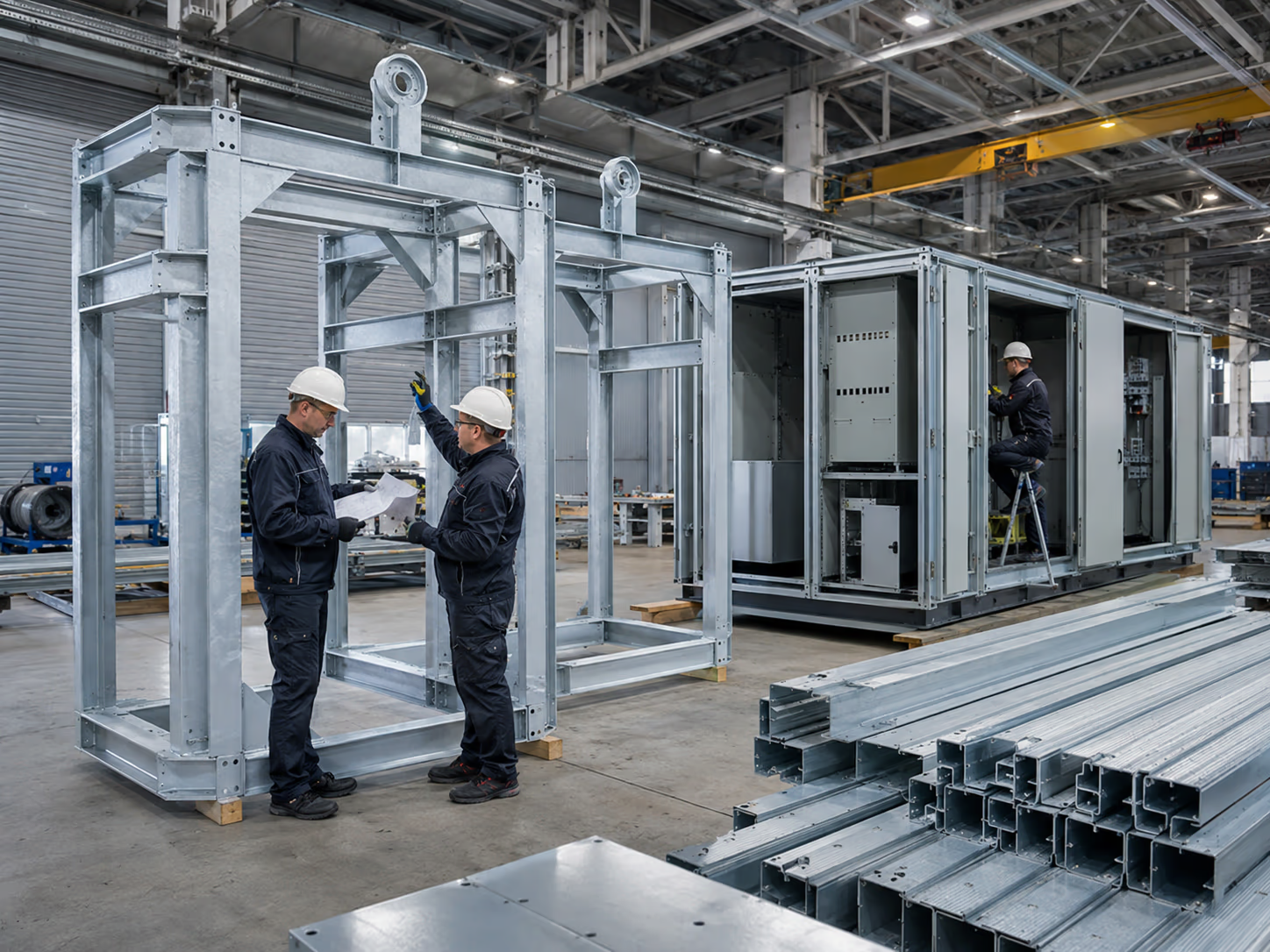
The tank carries the loads of the active part, oil, accessories, lifting points and transport. Its walls may be subjected to vacuum during manufacturing, pressure changes in service and transport loads. The applicable conditions depend on the transformer design. A tank should not automatically be treated as a conventional pressure vessel or assigned one universal test procedure.
Geometry and distortion
Large flat surfaces, nozzles, stiffeners and long welds react to welding heat. Defined assembly and welding sequences, fixtures, in-process checks, straightening and measurement after thermal operations are required.
Tightness
The transformer manufacturer defines the medium, pressure or vacuum, holding time, leak-detection method and acceptance criteria. Depending on the project, pressure, vacuum, penetrant or gas methods may be used.
Internal cleanliness
Abrasive residue, swarf, weld spatter, moisture or coating contamination can affect insulation and oil. Cleanliness control should form part of the quality plan, and openings must be protected during transport.
Acceptance and documentation
The acceptance scope should follow the contract and customer documentation. A positive final test does not replace material traceability, welding controls, dimensional records, test reports, coating documentation and repair records.
Surfaces for the cover, bushings, valves, radiators and active-part components must remain within tolerance after welding. If datum surfaces or holes require machining, the operation should be planned after welding and straightening, taking account of machine load capacity, fixturing and maximum travel.
The inspection plan should cover incoming material, plate identification, joint preparation, welding, repairs, dimensional inspection, non-destructive testing, tightness, cleanliness, surface preparation, coating and protection for transport.
Minimum acceptance-documentation package
- material certificates and batch traceability,
- welder list and welding procedure specifications,
- dimensional inspection records,
- NDT and leak-test reports,
- surface-preparation and coating reports,
- register of non-conformities, concessions and repairs,
- photographic documentation where required by the customer,
- statement of conformity with drawings and the approved specification.
The documentation scope must always follow the contract. A package from another product should not be copied mechanically, and no single test method should be presented as appropriate for every transformer tank.
Example process chains
Switchgear enclosure
A typical process may include laser cutting or punching, bending, welding of corners and reinforcements, grinding, surface preparation, powder coating, installation of hinges, locks, seals and mounting plates, dimensional inspection and packaging. The manufacturer of the empty enclosure is responsible for conformity with the drawings but should not independently declare the internal-arc classification or temperature-rise performance of the complete switchgear assembly.
Transformer frame
The process includes cutting profiles and plate, edge preparation, assembly in a fixture, welding, diagonal inspection, straightening, machining of datum surfaces and industrial coating. Lifting points, surfaces for wheels or skids and alignment of interfaces with the tank are critical.
Substation bracket
A bracket can be produced from profiles or plate by cutting, drilling, welding, marking and galvanising. Simple geometry does not remove the need to inspect holes and distortion or to consider how vent and drain holes affect safe galvanising.
Large tank
The process chain is substantially longer: material preparation, prefabrication of walls and stiffeners, assembly of sections, welding in a defined sequence, continuous geometry control, installation of nozzles, straightening, machining of datums and holes, weld examination, leak testing, internal cleaning, abrasive blasting, application of the coating system, final inspection and transport protection.
A robot can improve repeatability of long welds where geometry is stable and volumes are larger. It does not solve poor edge preparation, variable gaps or distorted semi-finished parts. For large one-off products, robot access, programming time and fixture cost may be disproportionate to the number of units.
ISO 3834, EN 1090 and surface protection
ISO 3834: welding-quality requirements, not proof of product capability
ISO 3834 specifies quality requirements for fusion welding of metallic materials. Part 1 supports selection between ISO 3834-2, ISO 3834-3 and ISO 3834-4. The standard can be applied in workshops and on site, but it is not a general management system for the entire company. The certificate alone does not demonstrate the ability to manufacture a large leak-tight tank. [13]
An audit should verify the actual certification scope, materials, welding processes, procedure qualifications, welder qualifications, welding coordination, storage of consumables, equipment control and handling of repairs. A plant may operate a valid ISO 3834 system but still lack the crane capacity, test station or experience required to control distortion in a large transformer tank.
EN 1090: application depends on product function
EN 1090 does not automatically apply to every tank, cabinet or enclosure. The decisive factors include whether the product is a load-bearing structural component in a construction works, how it is placed on the market and the project documentation. Guidance from Poland’s General Office of Building Control indicates that even the assessment of a guardrail requires its structural function to be determined; resemblance to a steel component alone does not establish the standard’s scope. The execution class should follow the design and the component’s responsibility. [14]
C4 and C5 are not complete paint specifications
C4 and C5 define environmental corrosivity categories under ISO 12944-2. They are not complete coating systems and do not state durability. An order should define surface preparation, cleanliness grade, profile, coating system, number of coats, nominal dry-film thickness, expected durability, application conditions, inspection and repair. ISO 12944-5 links system selection to the environment, surface preparation and expected durability, while laboratory tests under Part 6 support selection but do not provide an exact service-life prediction. [15]
Hot-dip galvanising, paint systems and duplex systems are not freely interchangeable. Galvanising requires suitable process holes and consideration of distortion risk. Painting provides greater control over appearance and local repair but requires disciplined preparation and application conditions. A duplex system can provide additional protection but increases the number of operations and quality interfaces.
The enclosure and the complete switchgear assembly
A metal enclosure is one part of the equipment. The integrator of the complete switchgear assembly is responsible for apparatus configuration, busbars, connections, earthing, insulation, heat dissipation and testing. The empty-enclosure manufacturer can guarantee dimensions, material, coating, doors, seals and conductive components in accordance with the drawings, but should not automatically declare the performance of the complete assembly.
The IP rating or IK impact resistance may depend on the final configuration, penetrations, ventilation, locks and assembly. Internal-arc classification concerns the switchgear’s behaviour during a defined arcing fault, not merely the strength of the sheet metal. Temperature rise depends on currents, busbars, apparatus and ventilation. IEC TR 60890 describes a calculation method for temperature-rise verification in low-voltage switchgear and controlgear assemblies and is linked to IEC 61439 requirements, illustrating the dependence between enclosure and installed equipment. [17]
The RFQ and contract should clearly separate responsibility for the empty enclosure from responsibility for the complete equipment, its testing and declared parameters. An unclear allocation can lead to disputes over IP, IK, temperature rise, internal arc, earthing or ventilation performance.
EU Regulation 2024/573 restricts the commissioning of new electrical switchgear using fluorinated greenhouse gases. The prohibition for medium-voltage equipment up to 24 kV applies from 1 January 2026; for equipment above 24 kV up to 52 kV it is intended to apply from 2030; and for certain high-voltage equipment above 52 kV up to 145 kV from 2028, subject to the exceptions in the regulation. The change strengthens demand for new equipment architectures but does not determine whether enclosures will be larger, smaller or easier to manufacture. [16]
Qualification of a Polish supplier
The process should begin by defining a product family, not by asking generally about “available capacity”. The buyer first defines dimensions, weight, material, responsibility level, processes, coating, documentation and volume. Only then should potential plants be identified, an NDA signed and RFQ documentation released.
Define the component and requirements
Specify function, dimensions, weight, materials, tolerances, special processes, testing, coating, documentation and volume.
Identify suitable plants
Build a longlist based on actual processes, infrastructure, experience and location without treating a directory listing as proof of capability.
Verify dimensions, weight and material flow
Check crane capacities, door dimensions, assembly space, ability to rotate the product, internal transport and removal from the hall.
NDA and documentation
Release drawings, models, bills of materials and specifications in a controlled manner with an unambiguous revision status.
Assess feasibility and quotation
The supplier should identify manufacturing observations, risks, fixture needs, external processes and assumptions affecting price and lead time.
Plant audit
Assess processes, personnel, quality system, traceability, welding coordination, measuring equipment, documentation and subcontractors.
Sample or first article
Manufacture the component using the target or agreed process, including dimensional inspection, tests and the complete document package.
Approval and controlled ramp-up
Approve after reviewing the results and increase the share of the new source only after further conforming batches rather than moving the entire volume after one sample.
Monitor quality and delivery
Continuously assess non-conformities, on-time delivery, documentation changes, capability of critical processes and effectiveness of corrective action.
Audit questions, expected evidence and warning signs
| Assessment area | Question for the supplier | Expected evidence | Warning sign |
|---|---|---|---|
| Dimensions | What component can be assembled, rotated and removed from the hall? | Plant layout, door dimensions and examples of similar products | Quoting only the laser-bed dimensions |
| Weight | What is the maximum weight at the workstation and in internal transport? | Crane, lifting-beam and floor capacities | No centre-of-gravity analysis |
| Welding | Does the procedure range cover the required material and thickness? | WPS, WPQR, welder qualifications and supervision | Certificate without matching scope |
| Geometry | How are distortion and post-weld datums controlled? | Fixtures, measurement plan and sample reports | Final inspection using only hand tools |
| Materials | How is traceability maintained? | Material register, marking and certificates | Plate without batch allocation |
| Tightness | Which methods can the plant perform and document? | Procedures, equipment and personnel qualifications | Claiming one method for every product |
| NDT | Who performs the tests and under which procedure? | Personnel qualifications, reports and laboratory agreement | No acceptance criteria |
| Machining | Can datums and holes be machined after welding? | Machine range, fixturing and maximum travel | Sufficient travel but inadequate load capacity |
| Coatings | Can the paint shop or galvaniser accommodate the product? | Chamber or bath dimensions, procedures and reports | No control of conditions or thickness |
| Documentation | Will the plant prepare a quality plan and complete acceptance package? | Redacted example documentation | Documents created only after a complaint |
| Capacity | What hours are available and where are the bottlenecks? | Load plan and list of critical operations | Dependence on one person or one machine |
| Changes | How are new drawing revisions implemented? | Revision register and blocking of obsolete documents | Uncontrolled printed drawings |
| Continuity | How are energy, material and external processes secured? | Contingency plan and alternative subcontractors | Single source for a critical service without backup |
RFQ and second sourcing
How to prepare the RFQ
External dimensions and quantity are insufficient for a reliable quotation. The supplier needs drawings, three-dimensional models, a bill of materials, grades and thicknesses, tolerances, welding requirements, NDT scope, leak-test criteria, post-weld machining, corrosion-protection system, cleanliness requirements, documentation and schedule.
The buyer should also state batch size, delivery location, packaging method, first-article requirements and responsibility for tooling. For transformer tanks, the documentation should clarify design responsibility, permitted manufacturing changes, repair procedure and conditions for customer witness during testing.
Frequently omitted information includes product weight, centre of gravity, post-coating tolerances, unpainted surfaces, closure of openings, documentation language, record-retention period and the concession-approval procedure.
Where a second source is most realistic
An alternative source is easiest to establish for parts with complete documentation and stable interfaces: plates, brackets, trays, covers, frames, smaller enclosures and CNC parts. Larger structures require fixtures, trial production and geometry comparison. For a transformer tank, qualification may take many months because it covers welding technology, testing, coating, transport and integration with the complete transformer.
The buyer should establish ownership of documentation and tooling, allow a period of parallel deliveries and define the point at which the new plant’s share will increase. Moving the entire volume after one positive sample creates unnecessary risk. A safer approach is to divide orders and expand scope gradually after further conforming batches.
Qualifying a new source can take longer than manufacturing the first product. The schedule must include audit, tooling, samples, tests, acceptance activities, document approval and possible corrective action.
Opportunities, SWOT and risks
SWOT of Polish energy-sector subcontractors
| Strengths | Weaknesses | Opportunities | Threats |
|---|---|---|---|
| Broad base of cutting, bending, welding and CNC companies; proximity to European customers; experience in one-off and low-volume production. | Fragmented capabilities; limited public data on actual dimensions and references; dependence of some companies on external paint shops and galvanisers. | Multi-year PSE and DSO investment; extended transformer lead times; capacity expansion by equipment manufacturers; demand for second sources. | Investment delays; steel and energy-price volatility; concentration of orders among a small number of customers; qualification cost; liability for delays and non-conformities. |
The International Energy Agency indicates that procurement of a large transformer may now take up to four years, approximately twice as long as in 2021, while prices of large transformers have increased by around 75% in real terms since 2019. These figures refer to the international market and advanced economies, but they increase pressure on European manufacturers and their supply chains. [10]
European manufacturers of transmission and distribution equipment have announced multi-billion-euro investments in capacity. A joint initiative by ENTSO-E, DSO Entity, Europacable and T&D Europe reported in 2025 more than EUR 9 billion of publicly announced investment by T&D Europe members and more than EUR 4 billion by the cable industry. The European Investment Bank also described a EUR 250 million guarantee mechanism intended to support up to EUR 2 billion of investment by grid-equipment manufacturers. [11] [12]
The difference between plans and implementation
The principal market risk is the movement of projects between years. PSE implemented 64.7% of planned capital expenditure in 2024, while the five largest DSOs achieved approximately 97% of plan. Delays in permits, engineering and outages can postpone demand even when the long-term investment need remains. [3]
Risks for the manufacturer
The supplier is responsible for leaks, incorrect material, distortion, coating quality and delivery. Testing, documentation, witnessed acceptance and repairs increase quality cost. In large structures, one non-conformity can occupy a workstation for weeks and disrupt the complete production schedule.
Dependence on external processes is significant. A galvaniser or paint shop may use the correct technology but have insufficient dimensions or a long queue. Transport between plants increases the risk of damage, flash rust and loss of schedule control.
Steel and energy-price volatility affects profitability where a long period separates quotation and delivery. The contract should define price validity, adjustment rules for significant material changes and responsibility for documentation changes. A fixed price without frozen documentation transfers disproportionate risk to the supplier.
Demand forecast for 2026–2030
There is insufficient data to forecast the value of the transformer-tank and enclosure market alone. The article therefore uses an index of demand for metal subcontracting, with 2025 = 100. The model is based on approved PSE plans, DSO plans, signed financing, the number of substation projects and European pressure on manufacturing capacity. [1] [2] [4] [5] [7] [10]
The index is not an industry-revenue or market-value forecast. It illustrates the likely direction of RFQ numbers and intensity. It is most sensitive to the pace of substation delivery, equipment manufacturers’ ability to increase output and the qualification time for new suppliers.
Scenario assumptions
| Assumption | Cautious scenario | Base scenario | Accelerated scenario |
|---|---|---|---|
| Implementation of investment plans | Project and outage delays | Close to average DSO implementation | Faster procurement and use of financing |
| Share outsourced to subcontractors | Stable | Moderate increase | Intensive establishment of second sources |
| Qualification of new suppliers | 12–24 months | 9–18 months | 6–12 months for simpler parts |
| Availability of steel and processes | Periodic disruption | No persistent shortages | Good protection through framework agreements |
| European demand | Weaker industrial conditions | Continued high level of grid orders | Further extension of OEM order books |
Metal-subcontracting demand index, 2025 = 100
| Year | Cautious | Base | Accelerated |
|---|---|---|---|
| 2025 | 100 | 100 | 100 |
| 2026 | 102 | 108 | 112 |
| 2027 | 105 | 115 | 125 |
| 2028 | 107 | 122 | 138 |
| 2029 | 108 | 128 | 150 |
| 2030 | 110 | 132 | 160 |
In the cautious scenario, demand remains above the 2025 level but growth is spread over a longer period. In the base scenario, growth results from implementation of the DSO portfolio, continued grid orders and moderate expansion of outsourcing. In the accelerated scenario, schedule pressure encourages manufacturers to divide packages and establish alternative supply sources.
Recommendations and limitations
Recommendations for Polish manufacturers
A company without energy-sector references should select one product family and prepare a capability sheet covering maximum dimensions, weight, materials, thicknesses, processes, tolerances, crane capacity, assembly area, machining range, coatings and tests. A general machine-list presentation is insufficient.
The most practical route is to begin with parts that have limited functional risk but require repeatability. After several conforming deliveries, the company can move towards frames and larger assemblies. A large transformer tank should become a target only after experience has been gained in leak-tight structures, distortion control and customer-witnessed acceptance.
Welding qualifications, material traceability, calibration of measuring equipment, revision control and coating documentation should be organised early. Investment in a machine makes sense only after the complete process chain has been considered: the cut part must still be bent, assembled, rotated, welded, measured, painted and shipped.
Recommendations for buyers
The first step should be to divide the portfolio into critical parts and parts that are easier to transfer. Minimum hall dimensions, weight, processes, certificates, testing and documentation should be defined for each family before a longlist is built.
The audit should follow actual material flow, not remain in a meeting room. The buyer should trace the route from plate receipt through marking, preparation, welding, measurement, surface processing and dispatch. Particular attention should be paid to operations performed outside the plant and to who has authority to approve repairs.
Several qualifications can be run in parallel for enclosures, supports, frames and machined parts. For leak-tight tanks, a staged project with a trial structure, complete inspection plan and customer-quality specialists present is more appropriate.
Interpretation limitations
Investment plans may be delayed, and the PSE draft for 2027–2036 may change during the approval process. Large packages are normally contracted through equipment manufacturers and main contractors. The operator is not required to disclose how contract value is divided among metal components.
The buyer should include the cost of audits, trials, tooling, testing, supervision and document retention. The supplier should include warranty cost, capacity buffers, complaints and the risk of unused workstations after the project.
Dependence on one customer may require dedicated tooling and personnel without a guarantee of follow-on orders. Excessive customer fragmentation, on the other hand, increases the number of standards, paint systems and documentation formats. The portfolio should be built deliberately.
Conclusions for buyers and manufacturers
Modernisation of Poland’s electricity networks creates a durable demand base, but access to orders depends on the company’s place in the supply chain. The strongest candidates are plants that can define the limits of their capabilities, take responsibility for the process and document the result. For a buyer, the decisive factor is not the number of machines but the ability to manufacture a specific component to the agreed geometry, quality and schedule.
A search for a transformer tank manufacturer in Poland should begin with requirements for dimensions, weight, distortion, tightness, cleanliness, post-weld machining and the acceptance package. For enclosures, brackets, frames and CNC parts, alternative sources can be created more quickly, provided that documentation and first-article control are managed correctly.
Target Solutions Poland can prepare a market map, identify manufacturers by product dimensions and weight, verify declared processes, ISO 3834, EN 1090 scope and coating capability, and support RFQ preparation, bid comparison and preliminary plant qualification. A typical project could involve finding two alternative manufacturers for leak-tight transformer tanks, welded bases and medium-voltage switchgear enclosures with corrosion protection and complete quality documentation.
Frequently asked questions
Can every company certified to ISO 3834 manufacture transformer tanks?
No. ISO 3834 confirms a defined welding-quality system, but it does not prove that the plant has suitable cranes, workstations, distortion-control experience, leak-test procedures or the capability to manufacture a tank of the required weight and geometry. The certification scope must be compared with the materials, thicknesses, welding processes and actual product.
Is EN 1090 required when manufacturing switchgear enclosures?
Not automatically. Application of EN 1090 depends on the structural function, intended use, method of placing the product on the market and project documentation. An empty enclosure does not become subject to EN 1090 solely because it is welded from steel.
How is a transformer tank tested for leaks?
The transformer manufacturer’s documentation or the agreed specification defines the method, medium, pressure or vacuum, holding time, leak-detection method and acceptance criteria. Different projects may use different tests. There is no single procedure suitable for every transformer tank.
Which substation components can SMEs manufacture?
The most accessible products include brackets, mounting plates, cable trays, covers, smaller enclosures, frames, platforms, guardrails and CNC parts. Larger bases, cabinets and support structures are also achievable where the plant meets the requirements for geometry, welding, coating, transport and documentation.
Can the supplier also be responsible for painting or galvanising?
Yes. The process can be performed internally or by an approved subcontractor. The main supplier should control the specification, surface preparation, process conditions, coating thickness, repairs, documentation and transport protection.
How long does qualification take and which documents are required?
Qualification of simpler parts may take several months, while large structures and leak-tight tanks often require twelve months or more. The buyer typically reviews certificates, procedure and welder qualifications, material certificates, inspection plan, dimensional records, NDT reports, leak-test documentation, coating report and the register of non-conformities and repairs.
How can a buyer find a second Polish supplier of energy-sector enclosures and structures?
The component, dimensions, weight, materials, processes, tolerances, coating and documentation must first be defined. Potential plants should then be identified, their actual technical scope confirmed, an audit performed and a first article or pilot batch ordered. A company directory alone does not prove manufacturing capability.